Women’s History Month Profile: Velvet Brown

March feature! Each week I will profile a different woman or women in music who are particular heroes or inspiration for me.

This week, please welcome to the stage

MS VELVET BROWN!

Monarch-Brass-05[Velvet-Brown]

Velvet Brown is professor of tuba and euphonium at Penn State University. She also maintains an active schedule of performances, clinics, and master classes. In 2002 she appeared at the University of Wisconsin-Madison, where a young yours-truly met her and followed her schedule religiously. As an icon for young women seeking professional careers as a soloist, teacher, composer, or recording artist in the brass world, she is inspirational.

In addition to collaborating with several prestigious performing groups she has recorded four of her own solo CDs and both commissioned and composed her own works.

She’s the tuba player for the Stiletto Brass Quintet, an all-female super group that’s been winning recognition around the world for their superior performances.

Check out her first album, Velvet, which has been a staple of my collection for a long time.

In the meantime, listen to Velvet Brown perform “How Beautiful” by Barbara York:

Weekly Roundup 3/17/15

Reading: It’s been a busy week! I haven’t had a chance to start any music-related books.

Practicing: Red Dragonfly, and Arthur Pryor’s Annie Laurie which I may perform with Metro Brass in the future.

Rehearsing: Exultate recorded the Requiem on Thursday and Friday. There will be an album released in May! In the meantime you can watch our performance from St Mark’s online (see link in previous post).

We read Scheherazade (Rimsky-Korsakov), Lemminkainen’s Return (Sibelius), and Oberon Overture (Weber) in Minnehaha Repertory on Saturday.

Performing: After a busy week of performances and recordings, it’s nice to have a little break! Metro is gearing up for a showcase concert in June. More info soon.

Listening: Abigail Washburn hit my radar yesterday and I can’t get enough of her. She’s a banjo player and vocalist who creates some truly sublime music.

Teaching: Musicality involves lots of moving pieces, but in many situations if you can hear the whole picture, it makes it easier to pull it all off. This week I’m helping students play musically by incorporating the micro into the macro.

Relaxing: My friend David is moving to Seattle, and he stopped in Minneapolis this weekend to catch a breather from the road. We spent an afternoon walking around Minnehaha Falls Park and eating good food.

Women’s History Month Profile: Megumi Kanda

March feature! Each week I will profile a different woman or women in music who are particular heroes or inspiration for me.

This week, please welcome to the stage

MS MEGUMI KANDA!

Unknown

I wanted to be like those women, strong but elegant, and to make a path for other girl trombonists.

Tokyo native Megumi Kanda is one of the few women in the United States (or the world, for that matter!) to hold a trombone position in a major orchestra. She stole the scene at Milwaukee Symphony Orchestra in 2002, winning the audition so resolutely the committee bypassed the trial period generally reserved for new musicians.

She began playing trombone at the age of 10 in Japan and moved to the United States to study at Cleveland Institute of Music with James DeSano. Prior to winning her MSO gig she played with the Rochester and Albany orchestras.

Most recently composer Amy Riebs Mills wrote a piece for her called “Red Dragonfly”, using thematic elements from one of Ms Kanda’s favorite Japanese songs. She premiered the work in 2013 at the International Trombone Festival in Columbus, Georgia.

She’s also performed as soloist in front of her own orchestra, and more information on that and her work so far can be found here: http://www.jsonline.com/entertainment/arts/113082274.htmlmegum

Weekly Roundup 3/10/15

Reading: Creole Trombone: Kid Ory and the Early Years of Jazz by John McCusker. An engaging look at an early jazz trombone hero and how his style influenced the development of a genre.

Practicing: Red Dragonfly, Pryor’s Annie Laurie, Kopprasch Book II.

Rehearsing: Midnight in Moscow meets tomorrow night and I’ll be sharing some of my insight from the Kid Ory book.

Performing: Exultate performed Mozart this past weekend and it went very well! Sunday was my best performance, but they were all great. Kudos to my colleagues Keith and David for their stellar performances (in particular David nailed the Tuba Mirum solo every time). We are recording Thursday and Friday, so soon you can purchase a recording of our brilliance!

Listening: The new Brandi Carlile album (The Firewatcher’s Daughter) is fantastic. I can’t get enough of Sleater-Kinney’s No Cities To Love.

Teaching: Relaxation in the higher register, and how to use our ears to our advantage and avoid strain.

Relaxing: BIKING ALL THE PLACES.

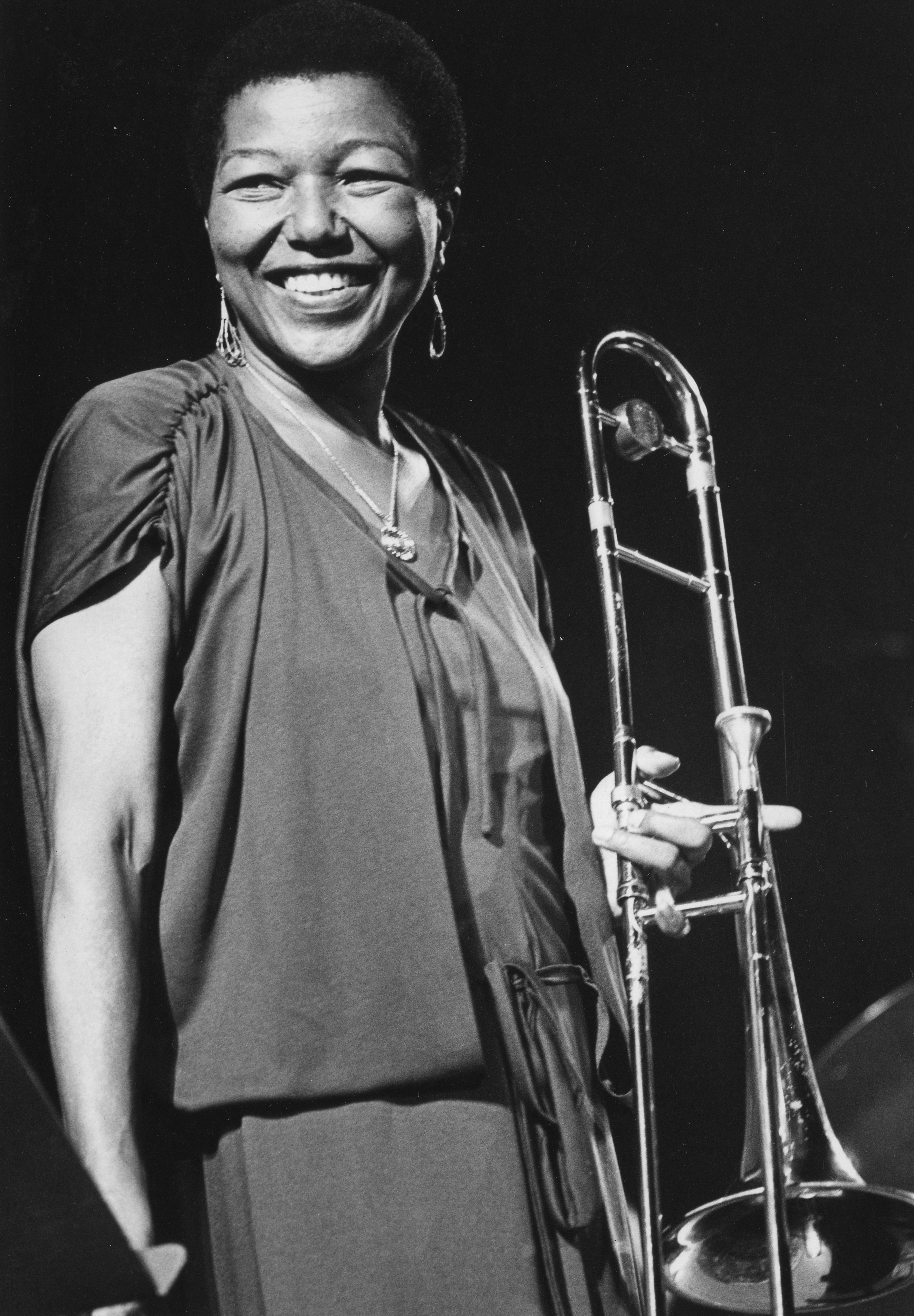
Women’s History Month Profile: Melba Liston

March feature! Each week I will profile a different woman or women in music who are particular heroes or inspiration for me.

This week is someone new to me but immediately important. Please welcome to the stage

MS MELBA LISTON!

cue-476-MELBA-STANDING-@-KC-FEST-COMER-AND-GREGG-updated-7-20-10-PNG

When I saw the trombone I thought how beautiful it looked and knew I just had to have one. No one told me that it was difficult to master. All I knew was that it was pretty and I wanted one.

Jazz trombonist, arranger, composer, and band leader, Melba Liston toured with Billie Holiday, Dexter Gordon, Dizzy Gillespie, and John Lewis. She began playing trombone around the age of 8, and was largely self-taught. At 16 she started her professional career at the Lincoln Theatre in Los Angeles, and by her 20s was on the road with some of the biggest jazz performers of her day. Her career spanned 40 years, encompassing her own studio album, Melba Liston and Her ‘Bones, writing and arranging for Quincy Jones, teaching music in Los Angeles and Jamaica, and even a short stint as an actress in Hollywood.

A good deal more information about the life and career of this amazing, unsung woman from jazz history can be found here: http://www.randyweston.info/randy-weston-sidemen-pages/melba-liston.html

You can find her album on iTunes and GooglePlay, and listen to tracks on YouTube. Here’s “Blues Melba” featuring the true first lady of the slide trombone, Melba Liston.

Weekly Roundup 3/3/15

Reading: Keys To Natural Performance For Brass Players, Robert D Weast. An older book but a goodie.

Practicing: Red Dragonfly is still on my stand, as is the second Kopprasch book.

Rehearsing: Mozart Requiem with Exultate Choir and Orchestra. I’m playing bass trombone. See below!

Performing: 3 concerts of Mozart Requiem with Exultate, March 6, 7, 8. Various locations around the Cities! Come and enjoy.

Listening: M. Ward, End of Amnesia; Jenny Lewis, The Voyager; Heart, Dreamboat Annie; R&B songs (by the likes of Stevie Wonder, Thelma Houston, James Hunter, Etta James, etc) as research/arrangements for The Satellites, my soon-to-be-gigging soul/r&b group.

Teaching: Rhythmic recognition and dictation this week. Get ready. You’re going to clap and count.

Relaxing: Walked by the river last night with my friend Susan and her dog Maple. Signed up for 30 Days of Biking again (year 4 for me!). Dreaming about spring.

Why Students Really Quit

Why Students Really Quit Their Instrument (and how parents can prevent it)

An interesting look at what motivates young musical learners.

Some pertinent quotes as they relate to taking lessons:

Students don’t know how to get better.  Without the proper tools and practice habits to get better at anything, students will become frustrated and want to quit.  It is the role of music educators and parents to give students ownership over their learning.  Teachers must teach students why, how, where, and when to practice, and parents must obtain minimal knowledge about how students learn music in order to properly support them at home.

Most of learning an instrument is learning how to practice, and your private teacher is there to guide you to efficiency in this regard.

Students discontinue playing over the summer.  Statistics show that students who do not read over the summer find themselves extremely behind once school starts — the same goes for playing an instrument!  A year of musical instruction can quickly go down the tubes over the summer vacation if students do not find small ways to play once in a while.  Picking up an instrument for the first time after a long layoff can be so frustrating that a student will not want to continue into the next school year.

I offer summer lessons, and I think they can be some of the most fun. We get more opportunities to play fun things and grow creatively when we can guide our own studies.

The instrument is in disrepair.  A worn down cork, poor working reed, or small dent can wreak havoc on a child’s playing ability.  Sometimes the malfunction is so subtle that the student thinks they are doing something wrong, and frustration mounts.  Students, parents and teachers need to be aware of the basics of instrument maintenance and be on top of repairs when needed.

Instruments that are hard to play are not fun to play. Let me know if your horn needs help, and I will recommend a good repairperson (I know several)!

And parents, I am always available to help you understand what your child is learning from me (and why!).

Happy practicing!

2015 Upcoming extracurricular opportunities

Students, teachers, friends:

There’s a life outside of school band! I strongly encourage all my students, regardless of ability or level, to find additional opportunities to perform and practice their craft. This might be playing duets with friends, or putting together a chamber group. There are also several groups around the Cities that put together talented young musicians to create art.

For students interested in orchestra performance, I recommend looking into either Minnesota Youth Symphonies or the Greater Twin Cities Youth Symphony.

MYS Auditions for low brass are Saturday, June 13th.

GTCYS Auditions for low brass are May 30th, 31st, and June 6th.

For the trombone student who wants to dive deeper into the intricacies of the instrument, I highly recommend the Shell Lake Arts Center Trombone Workshop. My friends and colleagues John Tranter and Phil Ostrander run this week long retreat in Shell Lake, WI. There is a possibility I may stop by as a guest artist!

In addition to the Trombone Workshop Shell Lake offers a whole summer of wind bands, orchestras, and jazz ensembles! I highly recommend you take a look at their offerings.

For those who want to ROCK OUT this summer, West Bank School of Music runs three weeks of youth rock camps. I will have more information about this soon, including exact dates.  You do not need to know how to play a rock band instrument; we will teach you! And we’ll have plenty of opportunities for brass players to shine.

If you’re interested in chamber music, I can put you together with other interested students! I currently have three students in a trombone trio, and I can connect with other teachers to create brass quintets, quartets, choirs, you name it!

Hey, I can tell when you haven’t practiced

Listen, I was a student, too, and I have gone to my share of lessons unprepared (but I only did this once for Jan at North Texas, and received a well-deserved lashing for it). I have also tried to hide this fact, or cram before the lesson, in order to not disappoint my teacher.

It never works. As a teacher now, I can tell you this: we can always tell. It would be much better for you to say, hey, I haven’t looked at this, I’m sorry, than to fake your way through something. Chances are I’ll be disappointed, but we can find a way to make the lesson productive: Either you can demonstrate how you WOULD have practiced it had you made the time, or we can work on some other aspect of technique or theory.

Now, that doesn’t mean we can spend every lesson avoiding what you didn’t have time to do. I expect that my students find the time during the week (it doesn’t have to be much; 20-30 minutes a day maybe, is better than bigger chunks with gaps in between) to work on what I’ve assigned. You take lessons because you want to progress beyond the skills you need for band, or to match them, or to get access to different music than you might otherwise. There are lots of reasons to take lessons, and lots of reasons for me to have certain expectations about how you will act upon them.

So, how do we get around this dilemma? How do you practice ‘enough’ to ‘fool’ me? Well, first of all, you don’t need to fool me. I am here to help you, and so that means if something gives you trouble, I should be the first to know. If you’ve worked for ages on these two bars and just can’t get them, maybe I can help you move beyond them. You don’t have to be perfect, just prepared.

Now, time management. Kids, and adults, these days, are BUSY. Does anyone know what free time is anymore? How does music fit when it competes with homework, athletics, clubs, friends, downtime?

You could always think of your music practice as homework. 30 minutes of something you have to do every evening even if you don’t have a class the next day. You could think of it as athletic conditioning, which is constant. You could envision it as a project you do for a club that ensures your participation is 100%. You could make music with friends or practice as a way to relieve stress from everything else.

There’s no right or wrong answer here. The only right way to go about managing your practice time is to make sure you’re focused and consistent. And if you’ve been focused and consistent in your personal practice, that will show in your lesson. That will give us something to move forward on.

Happy practicing!