Brass Lassie’s Debut Album: Over 50% Funded!

26992653_174165953197090_3183548833650081162_n

Brass Lassie’s Debut Album Fundraiser hit 50% exactly one week after we launch it- and it’s still going steady! We are a little ways off from our goal still, but the momentum is truly tremendous and humbling. If you’ve supported, thank you! Could you take a moment to share our music with your friends and encourage them to make a pre-order as well? If you haven’t- check us out!

https://www.youtube.com/watch?v=4DgGsPQ5EtQ

 Brass Lassie Homepage

Brass Lassie on Facebook


January Topic Article: Why Music Matters

This month I’m thinking and writing on #whyImakemusic, and on Wednesdays I want to share articles and resources that have gotten me thinking about why music matters to me and how I can better share my vision with the community.

A recent article in the Atlantic highlighted how jazz musicians communicate through improvisation, unsurprisingly using the parts of their brains dedicated to speech and syntax. On top of that- music has no discernible semantic meaning the way that speech does, because it means something different to each listener. When two musicians are improvising back and forth, they are talking- but they’re sharing more than just words.

From the article:

“If the brain evolved for the purpose of speech, it’s odd that it evolved to a capacity way beyond speech,” Limb said. “So a brain that evolved to handle musical communication—there has to be a relationship between the two. I have reason to suspect that the auditory brain may have been designed to hear music and speech is a happy byproduct.”

So in a sense- why I make music, why you make music, why most cultures have developed musical systems, has more to do with communicating beyond our normal language abilities than just developing something pleasant to listen to. And whether you make music or simply curate a listening library of your own, you engage in musical activity that fires up an important center of your humanity.

I make music…because music makes me human.

January Topic: Why Music Matters

Happy New Year, all!

I’m always excited about the psychological fresh start a turn of the calendar brings, and 2018 is no exception. I’ve got big professional and personal goals for the year and am feeling energized to Get Stuff Done.

I’m using this blog post to introduce a new series. Each month, I’ll pick a theme or a subject to blog about, share resources and articles relating to that topic, and ask you to weigh in on your thoughts.

January is a good time to think about what’s important to you, and where you want to take it. So my question to you this month is: Why does music matter? What does it mean to you? How do you see the importance of music in your day to day life?

On Fridays, I’ll ask you to share your photo, post, or video online with the hashtag #whyimakemusic and link back to me so I know where to find it.

For me, music is communication. Sometimes I’m socially awkward, or feel shy around new people. When I play, I have a tool I can use that breaks down those barriers, gives me a construct for conversation, and helps me express myself to others. When I teach music, I feel like I am helping my students unlock their inner creativity and utilize those same tools to make their world a better and more open place. Music can change lives, music can change history.

I can’t wait to see why music matters to you.

Lunch With Lauren Husting 12.4.17

Recently I was honored to perform for Sundin Hall’s “Lunch With” Concert series on the Hamline University Campus! “Lunch With” concerts are informal, 30 minute presentations that introduce audiences to a wide variety of styles and performers.

I chose to present a program of three works for low brass by different women composers, and was accompanied by my good friend and colleague Rebecca Hass.

You can watch the whole performance below. Enjoy!

Brass Lassie Album Fundraiser Kickoff!

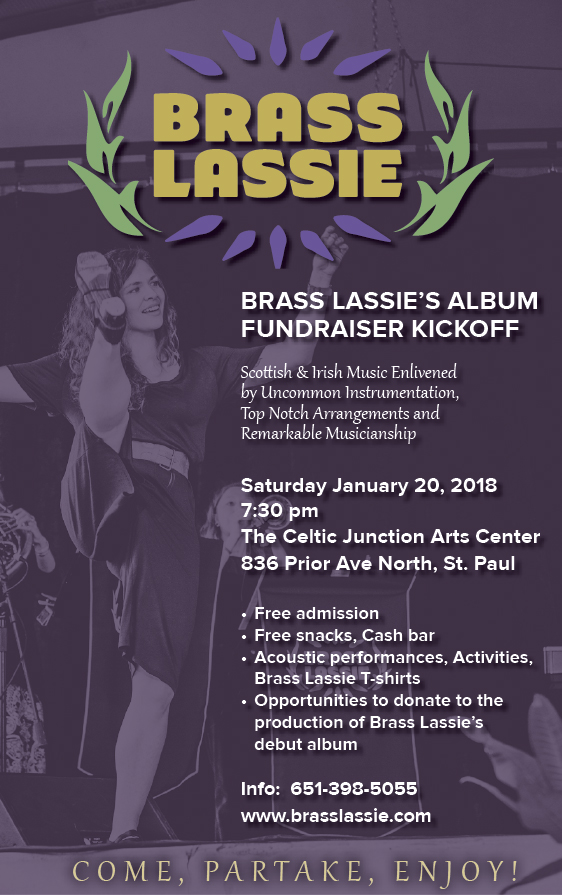
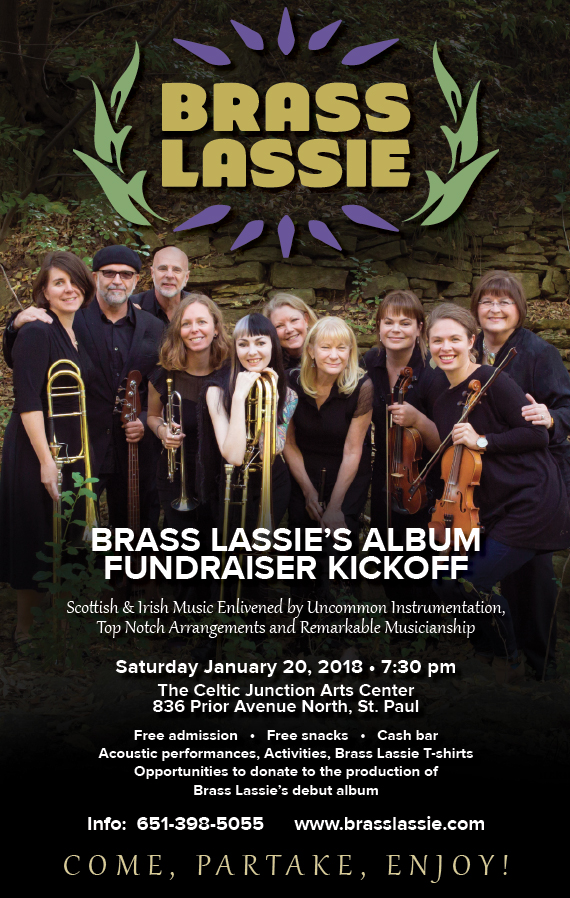
Brass Lassie is getting ready to go into the studio to record our debut album- but we need your help to do it! Join us on January 20th, 2018, at the Celtic Junction Arts Center as we launch our funding campaign to bring our music to you.

Donors will be an intimate part of the recording process- with regular updates on our progress, exclusive looks into the process, and lots of fun extra gifts and goodies in addition to the finished album!

See the posters below (and feel free to share them) for more info, or check out our Facebook Event for the details. We hope to see you there!

PS Brass Lassie now has a live webpage where you can find all our updates, sign up for our mailing list, and more!

An Autumn of Performances and Events

I’ve been doing a little marketing for the upcoming Brass Lassie concert, and it occurred to me that I have a busy fall filled with some amazing performances and events I hope you can make one or two.

Friday, September 29th, 2-4pm: I’ll be joining the Bubonic Brass for the Feast of Fantasy at the Minnesota Renaissance Festival. This event is ticketed separately from the Fair; visit the link for details.

Friday, October 6th, 5-7pm: my good friend and colleague Rebecca Hass and I are hosting the second meet-up happy hour for women and GNC folks in the MSP area. We hope to make these a regular thing, so we can strengthen our community and build new connections.

Sunday, October 8th, 7-830pm: October Studio Class featuring guest artist Gabe Mueller! Gabe is a lifelong friend and the inspiration for my studio classes- she hosts her own each month for her studio in St Louis.  (This is an event for members of my studio and their families only)

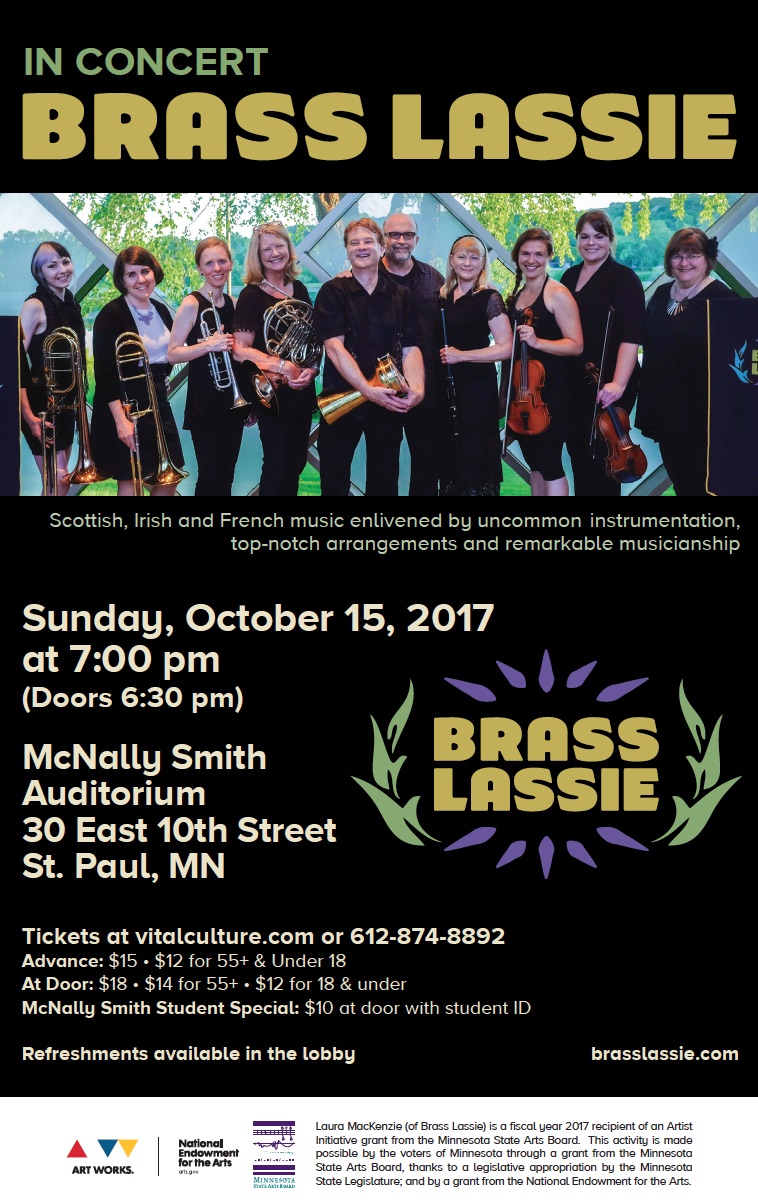
Sunday, October 15th, 7pm: The aforementioned Brass Lassie concert! Buy your tickets in advance for a discount.

Sunday, October 29th, morning: Reformation Sunday Services with Accent Brass.

Saturday, November 4th, 4pm: Hamline Wind Ensemble Parent’s Weekend performance

Monday, November 6th, 9pm (2 sets): The Adam Meckler Orchestra at Icehouse. I’m really honored to be invited to join the AMO this season on bass trombone (I even bought my very own bass, something I’ve needed for a while, and will share it with you when I get it!). If you’re up for Monday late night jazz, join us!

Saturday, December 2nd, 2-330pm: Hamline Wind Ensemble Winter Concert @ Sundin Hall

Monday, December 4th, 12-1230pm: ‘Lunch With…’ Lauren Husting and Rebecca Hass! This is a tasty little lunch concert featuring works by women composers written for low brass instruments and piano. This concert is free and open to the public.

Sunday & Monday, December 24-25, various times: Christmas services at St John the Baptist in New Brighton. Stay tuned for more details.

As always, I try to keep my gig calendar updated with all relevant information.


“Ear on the Prize”: Employing External Attentional Focus in Learning Brass Instruments

Part 6: EPILOGUE

Recently, I recapped the excellent text of studies related to attentional focus and its affect on motor skill learning by Gabriele Wulf. To review: where we put our attention when learning a new skill is important in the development of efficient and accurate movements and will contribute to longer-lasting results and quicker progress. Even at the very beginning level of a skill, an external focus will allow our bodies’ natural learning processes to take over and solidify our abilities.

In several installments, I’d like to tackle a few of those tricky concepts associated with learning the particular motor skills of brass playing, and offer some practical strategies for natural, effective learning.  I’ll address common methods, fads, and accepted techniques and then offer ‘external’ focus solutions for each.

Part 1: AIR

Part 2: EMBOUCHURE

Part 3: ARTICULATION and INTONATION.

Part 4: VALVES/SLIDE vs CONCEPT

Part 5: MUSICALITY

As a final installment, I want to talk about why teaching in this pedagogy is so important to me, and how it can help create a more inclusive, equitable society of brass musicians with healthy playing and performance habits first and foremost in our minds.

BUT WE’VE ALWAYS DONE IT THIS WAY

There’s a prevailing attitude in music instruction, especially at the upper levels, that seems to think that because their teacher drilled them endlessly on Arban scale patterns, made them buzz into embouchure visualizers and jump up and down doing inhalation exercises, or was just plain salty about the type of work it takes to get good, that we all have to go through that. Unless we’re ‘naturally talented’ in which case we’re held up on a pedestal of unattainable glory.

There’s ample evidence, however, that the school of technical execution, especially in brass learning, is a relatively new turn in a centuries-long history of pedagogical approaches. McPherson and Gabrielsson, in their book The Science and Psychology of Music Performance, attribute the publication of the Arban Comprehensive Method in 1864 as the first in a long series of texts intended to fill a marketing hole in the music publication world. It may not have been the intent of the authors involved, but it created a shift in brass education away from imitation and ear training (external) and developed a dependence on technical acquisition (internal). (McPherson and Gabrielsson, 2002; see also Karen Marston’s dissertation on Jan Kagarice with an overview of relevant brass pedagogies starting on page 52).

The purpose of this epilogue is to allow me to take a few hypothetical leaps, to explain the reasons I am deeply commitment to external focus pedagogy, and to provide some hope for change in the future. There’s future research in this for me, and I hope to refine and defend some of this arguments not long from now in academic form. SO! Here we go.

WHAT IF? 

What if a cultural approach to learning brass that focuses on technical acquisition, a strict checklist of music skills we need to be deemed ‘professional level’ and an iron grip on training interpretive performance skills (i.e. learning pre-composed music and performing to ‘industry standard’) is leaving a cohort of potential lifelong musicians behind, or excluding them from finding success in the music industry?

In other other words, what if training internally is turning off all the folks who can’t naturally approach systematic learning, who might have an improvisational or compositional voice, who might not need to read music or interpret the classics to share their musical inclinations?

What if we’re leaving young people (and in particular, young women and/or people of color) behind in the field of brass instruction because they’re struggling to interpret concepts that don’t actually relate to music performance, what if they’re turned off by the ‘higher, faster, louder, stronger’ school of thinking, that asks how hard they’re working, how uncomfortable they’re making themselves?

What if we’re hurting ourselves with our hyper-focus on technical instruction? What if the growing number of focal dystonia cases has something to do with teaching backwards, teaching muscle movements and breathing instead of sound concepts and air movement, making people maneuver instruments first and get music second?

What if performance anxiety is a facet of practice anxiety? What if when we don’t practice performance, but instead practice skills, we don’t know if we can trust them on the stage anymore?

IMAGINE

Imagine picking up an instrument and having your teacher, someone you trust and admire, model the sound they want you to create. Imagine them steadily helping you build your skills, keeping your ear trained to the goal you want, watching as you unlock your potential for musicality.

Imagine a community of musicians that holds up all performance genres and contexts as valuable, teaches any number of styles as inherently human, sophisticated creations, allows many voices to join the throng. Imagine people joyfully sharing their skills without fear.

Imagine a healthy way of approaching both horn and life- curious and open, communicative, expressive, kind, and giving. Imagine all the different faces and personalities we’d see in the brass world.

Imagine how much more fun that would be.

[some important further reading here: http://www.mtosmt.org/issues/mto.16.22.1/manifesto.pdf]

“Ear on the Prize”: Employing External Attentional Focus in Learning Brass Instruments

Part 5: MUSICALITY

Recently, I recapped the excellent text of studies related to attentional focus and its affect on motor skill learning by Gabriele Wulf. To review: where we put our attention when learning a new skill is important in the development of efficient and accurate movements and will contribute to longer-lasting results and quicker progress. Even at the very beginning level of a skill, an external focus will allow our bodies’ natural learning processes to take over and solidify our abilities.

In several installments, I’d like to tackle a few of those tricky concepts associated with learning the particular motor skills of brass playing, and offer some practical strategies for natural, effective learning.  I’ll address common methods, fads, and accepted techniques and then offer ‘external’ focus solutions for each.

Part 1: AIR

Part 2: EMBOUCHURE

Part 3: ARTICULATION and INTONATION.

Part 4: VALVES/SLIDE vs CONCEPT

In the last installment, I want to try to put all this together as MUSICALITY, which, theoretically, is the whole reason we want to play an instrument! It’s important to our souls and to our audiences that we express what we really feel using the instrument as a tool. It doesn’t matter what level we are at, we can tap into our inner musicality to help us ingrain new skills deep into our performance practice.

WHAT DOES THE MUSIC TELL YOU?

Even with very basic phrases, music has a life of its own. It’s up to us to unlock the potential of each phrase and bring a piece together, but if we spend a little time learning to listen, we can start to interpret music on a deeper level.

This is going to be one of my more controversial opinions. You don’t need fancy technical studies, you don’t need to spend chunks of your practice every day isolating specific skills. It’s great to know what you need to work on, whether it’s clearer articulation or better intonation across dynamic changes. Here’s the problem though: you’re reverse-engineering. You’re putting the cart  (skill) before the horse (concept).

We too often see making music as a sum of all its parts. We’ll work on how to better articulate. Then we’ll practice range. Then we’ll play some scales in patterns. Then we’ll practice long tone crescendo/decrescendos. AND THEN maybe we’ll play something lyrical and work on our phrasing. Later on, we’ll try to put it together into whatever etude or solo we’re working on and maybe feel frustrated that some of those things are ‘sticking’ or transferring over to the music.

I want to use a very recent example to show how I might tackle a student’s technical problem with a musical fix.

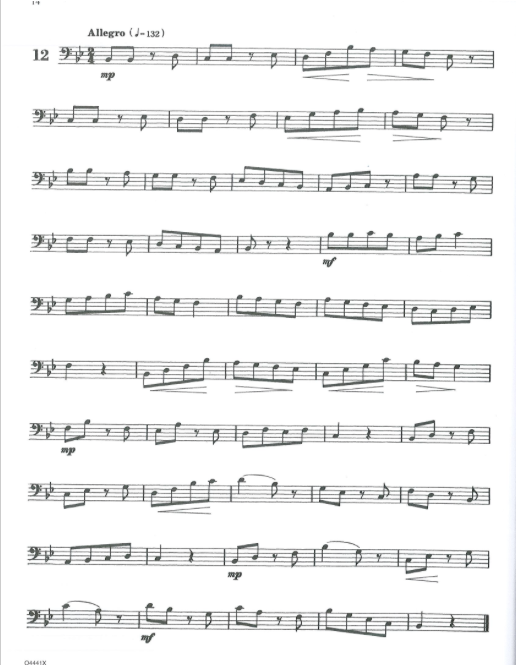
My student, EB, is working on Hering #12:

As has happened a few times before for her, she’s finding keeping 8th notes consistent to be a bit of a struggle, and it’s informing how she articulates. Even though she played most of the right notes (and did some excellent phrasing), the overall effect was a little jagged and out of time.

At first, I had her try just doing some simple 8th note patterns, trying to match with the metronome and keep it even. But it wasn’t really working and she was thinking about it too hard, so it was just frustrating. Instead, I took away the music and left the metronome on, teaching her the phrase by ear and having her imitate what I was playing as closely as possible. The difference was immediate, and suddenly we had the first two lines not only rhythmically accurate, but going faster than before, with great direction! When we went back to looking at the music, the results were retained. It was a really dramatic change and it only took a few minutes.

Engaging our ears and trying to recreate a goal is external focus. This is exactly how EB will continue to develop better timing and more control over how she communicates what she sees on the page. The music should be a guideline, not a script. In this way we are practicing performance, not performing practicing. Performance gets hard-wired into our motor skill network, and once that happens, it’s hard to shake! We’ll feel more comfortable on stage, better prepared and more likely to relax and enjoy the experience.

One of the things I love to do is play tunes by ear, in as many keys as I have time for in any given warm-up session. I like to make sure that I know tunes that are smooth and flowing, jaunty, articulate, soft, loud, fast, slow. I like tunes that I can play in all registers and think about the sweep of the music, not the really high notes or really low notes. What that’s given me is a flexibility in all areas of technique that is tied to the music I want to create. Rather than choosing from a box (hm, I need my staccato hat on for this one), I can look at a line of music and think, that looks like it needs to be delivered crisply, with flair. I’m not worried about delivering on a technical skill, as long as I can tie it to the music. And if something gives me trouble, I figure out how to incorporate refining that by using the dictates of the piece or song.

Tomorrow on my Facebook page, I’m going to do a little live demo of how I learn a phrase of music, utilizing external focus. I hope you can join me, or save to watch later!

This is technically the last installment of “EotP”- but there’s going to be a little epilogue! I want to look at the ways music education that adopts internal foci has created barriers and problems for players at all levels. Stay tuned.