“Ear on the Prize”: Employing External Attentional Focus in Learning Brass Instruments

Part 4: The VALVES/SLIDE vs CONCEPT/SLOW PRACTICE

Recently, I recapped the excellent text of studies related to attentional focus and its affect on motor skill learning by Gabriele : . To review: where we put our attention when learning a new skill is important in the development of efficient and accurate movements and will contribute to longer-lasting results and quicker progress. Even at the very beginning level of a skill, an external focus will allow our bodies’ natural learning processes to take over and solidify our abilities.

In several installments, I’d like to tackle a few of those tricky concepts associated with learning the particular motor skills of brass playing, and offer some practical strategies for natural, effective learning.  I’ll address common methods, fads, and accepted techniques and then offer ‘external’ focus solutions for each.

In Parts 1,2, & 3 we dove into AIR, EMBOUCHURE, and ARTICULATION and INTONATION.

Today, I’m looking at the VALVES/SLIDE, but more importantly, how we use CONCEPT and MEASURED PRACTICE to develop our technical skills in an externally focused manner.

MOVE IT OR LOSE IT

We’ve got our Arbans, our Clarkes, our Koppraschs, and any number of other texts, all engineered to help us develop fluid, fast technique on the horn so that we can master it. We practice scale studies and etudes and work hard on our execution. It’s definitely a necessity in obtaining a high level of performance on an instrument, so how we can we utilize external attentional focus methods to help lessen the task (and dare I say it- make it fun)?

I’m going to speak primarily from a trombone player’s perspective, since that’s what I play and mostly teach, but these ideas could apply to any instrument.

The main big idea I want to talk about today is CONCEPT- which has something to do with the ‘brain magic’ and ‘umbrella tasking’ I’ve discussed before. Basically, we need to be able to tell our body what the music we want to make sounds like, and so we rely on our concept to guide us. Too often, we go the other way- assess something as a technical skill, learning it as an action our body does and then trying to shoe-horn musicality in over it. We set students on the task of ‘learning their scales’ but we don’t always explain how those scales can show up in music or teach tonality instead. It’s just something we have to do to be better and it’s really boring.

But I think scales and drills can be fun, if you change your concept of them. An ascending scale pattern can have direction- aim for the top! pull down to the bottom!- thirds can be like skipping stairs, arpeggios outline cool chords that can be played underneath the student as they practice, showing them how Western harmony works. If we’re clear on our concept, we’ll have a better shot of integrating the technical skill we’re trying to accomplish into our skill set.

It is of utmost importance that we are helping our young musicians develop their ears. From an early age, they learn recognize sounds and intervals, and are seeped in harmonic structures and internal rhythm. As they begin learning a brass instrument, they can use those tools to conceptualize on the instrument more quickly and easily.

One of the hardest early skills to get on the trombone is a clean slide. Most of us start out slipping around and getting all the semitones between two pitches in the same partial, and have trouble lining up tongue, air, and slide to get a clean attack. Some approaches to going from F(1) in the staff to Eb(3):

Internal Focus: 

“Move the slide really fast and tongue right when you get to 3rd, trying to line the slide and tongue up together.”

External Focus:

“Let’s think of a song that uses this interval. Happy Birthday could start on Eb and go to F and then back- let’s sing that on those pitches (demo on piano). Can we hear those two notes cleanly on the trombone?”

Turn on a metronome. Encourage the student to arrive with the beat each next note, keeping that as their focus. Keep the tempo at a pace they can conceptualize and execute, and speed up slowly.

Another tricky skill is executing the whole step from F in the staff to the G above it. It requires changing partials and moving the slide from 1st to 4th. Most of the time, a beginner will end up glissando-ing down to the D in 4th before being able to make the upward change.

Internal Focus:

“As you’re moving out to 4th, make your air go faster and tongue on the G”

External Focus: 

“Let’s listen for Happy Birthday again, but this time let’s start on F. It’s going to go F-G-F, and we need to hear that interval as we play it. Let’s sing first!”

“Let’s try playing F in 6th position…did you know that was an alternate? Then, we can stay on the same partial and smear up to 4th. Listen (demo). Now, let’s try playing that cleanly from 6th to 4th. Once you have that, we’ll try 1st to 4th- let’s keep hearing a song we recognize as we do it!”

MEASURED PRACTICE

“Slow practice equals fast progress”- Musician’s proverb

One of the biggest lessons I learned in my studies with Jan Kagarice is that CONCEPT has to meet ABILITY, not the other way around. In other words, if we cannot play something at the speed we have heard it done or want to play it at, we need to lower that concept down to where we can play it. That doesn’t seem like rocket science, but it’s an important piece of the puzzle. This includes all of the elements of a given phrase: direction (dynamics), style (articulation), and execution (mechanics). In a sense, we need to practice performing at all levels of our learning process in order to truly cement the finished project in our bank of motor skills.

For beginners, clean slide/valve technique and faster passages can seem like daunting tasks. But with measured practice skills, bringing concept down to a manageable tempo can make the task more accessible. Adding external focus techniques such as “what is this phrase saying/what does this interval remind you of” will keep the learner’s attention on the execution and not on the physical skill.

This is easier for some than most, but it’s critical in developing fluid, easy technique that responds to the musical goal one is trying to achieve. A metronome can be a lifesaver in this regard- it gives the learner something to aim for rather than guessing blindly at where the next note will be when their sense of steady time has yet to develop. I never move a student faster than they can play any given thing, and in fact sometimes we end up going even slower. To keep from boredom setting in, I keep the task manageable and limit the amount of time we concentrate for. Our brains, in addition to not being able to multi-task, really need time to develop focused concentration abilities. So be patient with your young students and don’t make them do one thing for too long- vary the tasks and move incrementally.

As one of my students said recently: “I can’t play fast stuff! But I’m playing fast without thinking about it!”
“Ear on the Prize”: Employing External Attentional Focus in Learning Brass Instruments

Part 3: ARTICULATION and INTONATION

Recently, I recapped the excellent text of studies related to attentional focus and its affect on motor skill learning by Gabriele Wulf. To review: where we put our attention when learning a new skill is important in the development of efficient and accurate movements and will contribute to longer-lasting results and quicker progress. Even at the very beginning level of a skill, an external focus will allow our bodies’ natural learning processes to take over and solidify our abilities.

In several installments, I’d like to tackle a few of those tricky concepts associated with learning the particular motor skills of brass playing, and offer some practical strategies for natural, effective learning.  I’ll address common methods, fads, and accepted techniques and then offer ‘external’ focus solutions for each.

In Parts 1 & 2 we dove into AIR and EMBOUCHURE, and now it’s time to approach the concepts swirling around ARTICULATION and INTONATION (both of which involve the tongue and its many machinations).

WHAT DOES YOUR TONGUE DO? DOES IT MATTER?

The motor skill behind each of the concepts involved in this post utilize the tongue (and by an extent, the oral cavity), so they made sense to explore in one post. There are more opinions on what one is supposed to do with one’s tongue when articulating and tuning then there are trombonists in the world (ok, that’s hyperbole, but still), and it’s easy to get overwhelmed with advice from all sides of the equation. Just Google “how to tongue on a trombone” and you’ll get all the hot takes you could ever wish for.

“The Teachers do what they do; they tell the Student what they think they do; the Students think they hear what the Teachers think they said about what they do; the Students then try to do what they think the Teachers said about what they think they do.” – Denis Wick

But as you probably already know by now, if you’ve been following along with this series, WHAT we’re trying to achieve is far more effective a learning strategy than HOW we’re doing it.

Recently, Boston trombonist and bass trombone guru Douglas Yeo participated in a study that allowed him to see the inner workings of his mouth and throat while playing a modified trombone set-up while in an MRI machine. When I first saw this post, I was pretty wary. The last thing most brass instrumentalists need is more stuff to think about and more focus of attention on the symptoms of our playing process. And on top of that, while more trombonists while participate in this research, we have at the moment only one player demonstrating these exercises and extrapolating them as evidence for what is  proper playing technique.

I don’t want to seem like I’m denying that this is fascinating information to have, or that we can’t learn something from demonstrations like this. I think it could be very useful if we lived in a learning culture where we trusted the educational effects of external focus, and could view the results objectively while still moving forward with our attention on the music.

But unfortunately we don’t, and I can see a whole generation of trombone players and teachers pointing back to this study and inflicting detailed internal focus instructions on themselves and their students. And the result will be inefficient, amusical playing.

Disclaimer time: Some players and teachers deny that anything is happening with their tongue or throat when a brass instrument is played effectively. I am not one of those people; I believe all manner of things are happening! It’s pretty cool that our muscles and tendons and neurons can all work together to form beautiful sounds and music. However, I’m just going to say it: I don’t care what’s happening. It’s just a symptom, and I’m going to let it keep doing what it’s doing and not interfere. Again, the more I focus on the results I want, the more efficient my technique will be.

“A symptom is not a prescription for doing.” -Jan Kagarice

There is enough scientific evidence out there now to tell us that we are not capable of actually multi-tasking. We can ‘serial task’: i.e. switch rapidly from one high level task to another, or we can incorporate an automated task (like walking) into a high level task (like talking on the phone), but we can’t do two high-level tasks at the same time, especially if they utilize similar brain functions. (Source) (I find fault with the example given in this article, listening to classical music while reading, because I certainly cannot focus on both!)

When we provide our brass playing self sets of internal instructions at the same time- “Strike the tongue at the tip of the teeth and pull back while moving the slide rapidly into position and blowing”- we are asking ourselves to do this all at once, but we are really serial tasking. When we provide external instructions- “These notes all connect and they sound like this. Imitate what you hear”- we form chains of functions that can occur simultaneously because we are not giving them high-level concentration. It’s sort of like ‘umbrella tasking‘; combining all the elements of successful brass performance under the umbrella of our concept. It goes back to what I referenced earlier in the Wulf text:

This lines up with what Wulf calls “optimal attentional focus” (Wulf 149) and what I call “brain magic”. When we learn a complex skill, the components of the skill line up in a queue of actions, and if we want to be most effective, we will let the highest-level affect lead our focus. All other components will tick off without need for conscious intervention.  (Husting)

Ok! So you get the point. Whatever we’re trying to do, we should get out of the way and not interfere with the system. So let’s get back to it.

ARTICULATION

Internal Focus:

“Your tongue should strike the back of your top teeth and interrupt the air but not stop it”

External Focus:

“We’re playing Hot Cross Buns today. Do you know the words to the fast part? ‘One-a-penny Two-a-penny’. Let’s say that together- can you hear how clearly we articulate that when we sing it? Let’s imitate it on the instrument.”

[I love teaching my students simple songs and making sure they know the words. We don’t teach young children how to manipulate their tongue when they are learning to speak, so why not utilize the same type of mimicry for brass playing?]

Internal Focus:

“This scale is staccato. Play really short notes by flicking your tongue quickly and using a hard syllable”

External Focus: 

“This scale says to play it staccato. What kind of character could we give it? Bouncy? Cheeky? Let’s listen to what that sounds like on piano for reference”

INTONATION

I have to do a little more exposition here. There is no reliable INTONATION without reliable TONE. Before I even introduce my students to the idea of ‘playing in tune’, I train their ears to recognize that they are resonating the whole horn and matching whatever pitch I give them. It will take time for them to develop the capacity for fine adjustments, but it will be much easier if they are producing a good sound. If they are struggling to play something in tune, I might take them back a few steps to AIR and EMBOUCHURE. The idea that the position of our tongue, the shape of our oral cavity (because of the position of the tongue), and the relaxation or tension of our throat has an effect on intonation is not unprecedented: the shape and tension of physical objects determine pitch according to acoustical science. But don’t put the cart before the horse. Form follows function. Those physical objects have been fiddled with over centuries to find the desired sound and range du jour! All because someone had a concept, and they wanted to improve upon the form of the tool they were using to execute it.

Also, a note on tuners. I generally discourage overuse of tuners in my studio in favor of things like pitch drones and reference instruments with stable intonation (like an electric keyboard). I find that staring at a tuner turns the focus inward, and players start to fiddle with physical aspects rather than trying to blend or match a sound. There is one great (and really cheap) tuner on the app market, and that’s Tonal Energy. It has lots of great tools, like metronome and playback, but most importantly, it provides high quality drones in a variety of sound types (including trombone!) that allow you to really work on expanding your ear and your sound’s relative pitch.

Internal Focus:

“Move your tongue up or down to create a better/more in tune sound”

[What I’ve noticed about this: Moving my tongue around in my mouth really only affects the pitch if I’m not thinking about resonating my sound all the way out to the bell. If I’m effectively resonating my instrument with a good tone, moving my tongue around has little to no affect- UNLESS I give it an intention along the lines of “now I want to bend the pitch and make it sound lower/higher”]

“Watch the tuner and react to what you see”

External Focus:

“Listen to the drone pitch. Hum or sing along, and then move air against your balance point and resonant the instrument with that pitch. Only look at the tuner for confirmation, and then start the process over by refocusing on the drone sound.”

[Intonation also works differently in different settings. If you’re playing the melody, you’re going to play the melody in tune with itself, and your accompaniment will adjust (unless it’s a piano, haha) to you. If you’re playing with piano, you can play your phrase on the keyboard to see what it sounds like in equal temperament, and then imitate those relationships on your instrument.]

That’s a lot! But I think these are really important concepts to consider when trying to approach your instrument in the most efficient and healthy way. Stay tuned for Part 4- the topic of which is yet to be determined but will probably be something along the lines of slide technique- and a second live video soon!


“Ear on the Prize”: Live Video!

Earlier this morning I took to Facebook Live to talk through my concepts for healthy brass tone production and skill development. Please give it a watch and feel free to ask any questions or give feedback. I hope to refine this over time and produce some companion videos aimed at beginner and intermediate brass education.

“Ear on the Prize”: Employing External Attentional Focus in Learning Brass Instruments

Part 2: EMBOUCHURE

Recently, I recapped the excellent text of studies related to attentional focus and its affect on motor skill learning by Gabriele Wulf. To review: where we put our attention when learning a new skill is important in the development of efficient and accurate movements and will contribute to longer-lasting results and quicker progress. Even at the very beginning level of a skill, an external focus will allow our bodies’ natural learning processes to take over and solidify our abilities.

In several installments, I’d like to tackle a few of those tricky concepts associated with learning the particular motor skills of brass playing, and offer some practical strategies for natural, effective learning.  I’ll address common methods, fads, and accepted techniques and then offer ‘external’ focus solutions for each.

Last week we dove into AIR and concepts that can help us use it efficiently and effectively. Now let’s turn to EMBOUCHURE, another loaded topic in brass performance and instruction.

Is the embouchure SET or is it BLOWN?

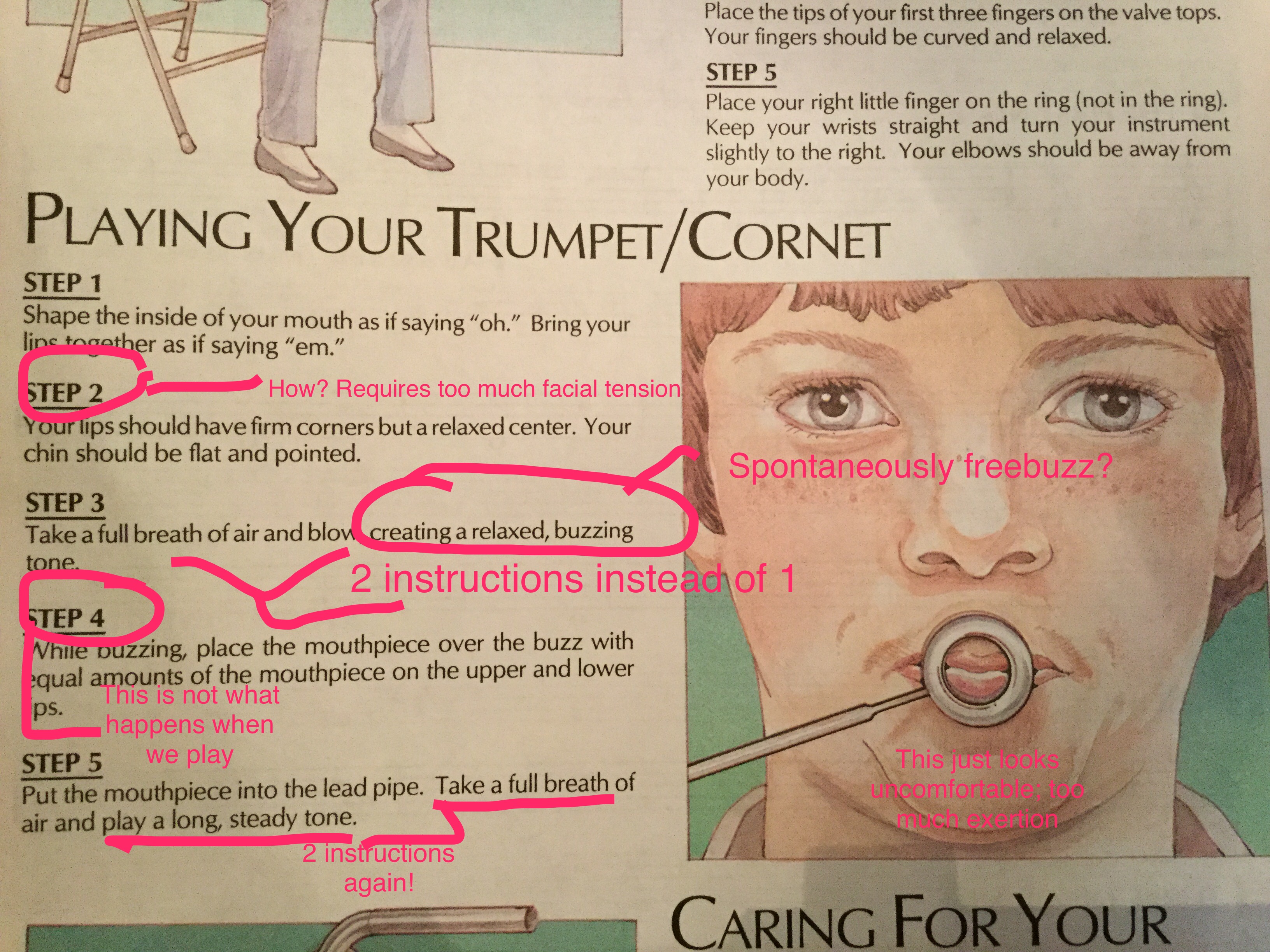
When we’re learning how to make sound on a brass instrument, our teachers might tell us specific ways to set up our face and air column in order to produce sound. There are as many different ways to describe this process as there are teachers that teach it. The most common approach is to have a new student say the syllable “m”- and set their mouth in that position. They may also be told to tighten the corners of their mouth as though they were sucking on something sour. Those readers who’ve been following along might already know the reasons this initial approach doesn’t actually help develop long-lasting and efficient skills. It’s internally focused: we’re being told to offer functional commands to our muscles in order to enact a specific result, instead of asking for the specific result and letting our muscles develop natural processes for achieving that effect.

Additionally, we might be asked to create a buzzing sound as if we were blowing a raspberry at someone, and in order to that we’ll have to tighten our lips and really force air through them. The sound we get is not pretty, and it’s not how embouchures form.

The truth is, our embouchure is formed only through the production of an air column through our open lips. The scientific principle known as the Bernoulli effect will bring our lips together, allowing for vibration to occur with the air.

If a small volume of fluid is flowing horizontally from a region of high pressure to a region of low pressure, then there is more pressure behind than in front. This gives a net force on the volume, accelerating it along the streamline. (Wikipedia)

As we move air down a tube, our faster moving air will meet still air inside the tube, in what is called the balance point. At the balance point, there is a moment of resistance– the fast air will move everything forward and create resonance, and the backward effect will be low pressure on our lips, pulling them together to create our embouchure. (The best information out there on this subject comes from Jan Kagarice, and is outlined on pages 196-207 in Karen Marston’s excellent dissertation here: Finding The Balance: Jan Kagarice, a Case Study of a Master Trombone Teacher)

And if we’re using an external focus such as a balance point or direction for our air column, we’re utilizing the age-old natural law, “form follows function.” What we want will make the how happen. By focusing on how we do something, we’re going backward. We’re undoing the process. By focusing on the effect we want, we’re allowing our natural learning process the opportunity to try out what works, thereby developing the best technique for the command.

Now, once we have all that set up, and are moving air and allowing for relaxed, natural embouchure vibration, how do we get it to make the sound we want?

Right now, go ahead and read that above sentence out loud. Did you think about how those sounds came out of your vocal chords? Did you shape your mouth intentionally or focus on your tongue’s ability to articulate the syllables?

Nah. You didn’t do that. You just read it. You visualized the words and the words came out. And you didn’t learn to speak as a child by being instructed on the proper technique of talking. You started by making sounds and imitating your family, and gradually you developed better and better control of your functional language capacity.

And if it’s that natural to learn to speak, why shouldn’t we apply that tactic to brass playing?

 Because there is a sensation of blowing against something within the horn, activating the balance point results in sensory feedback for the player. As the amount of resistance changes, i.e. as the player alters pitch, there are corresponding shifts within the feel of the airstream itself. By focusing on this phenomenon, the player can become sensitized to the changing air pressures which control pitch. In order to make this information useful, it must then be systematically linked with musical statements so that the body can map sensory and aural information and over time learn to navigate the instrument efficiently in all registers. The player hears the target pitch and blows it into place on the instrument, eventually merging these two capacities into a feel, or sensory memory. Once this is absorbed by the player s/he no longer has to directly focus on finding the balance point. The process becomes automated. (Marston 204)


Internal focus: 

“Tighten the corners of your lips and blow really hard into the instrument”

This information really does exist in the world! See the photo below, and also as much of this video as you can stand:

External focus: 

“Horn comes up, air moves out”

Internal focus: 

“To play a low Bb, drop your jaw as if saying “oh” and blow really slow, warm air into the horn”

External focus:

“Sing this Bb. Think about how the horn would sound playing that. Let your air move down the bell and think about the sound of Bb.”

Internal focus: 

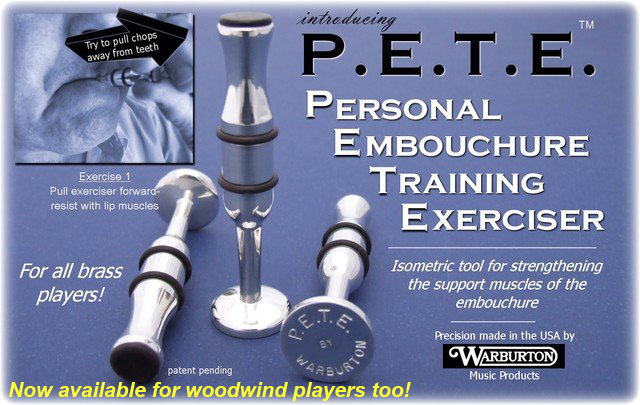
Everything in this picture.

External focus: 

Providing an example of a good brass instrument sound and, without giving too much instruction, helping your student reproduce their version of that sound.

Internal focus: 

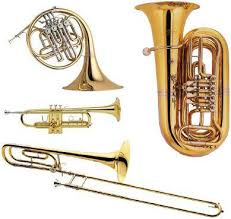
Whatever these are.

[I have a long rant coming about maladjusted concept of putting ‘strength’ development first when it comes to playing.]

External focus: 

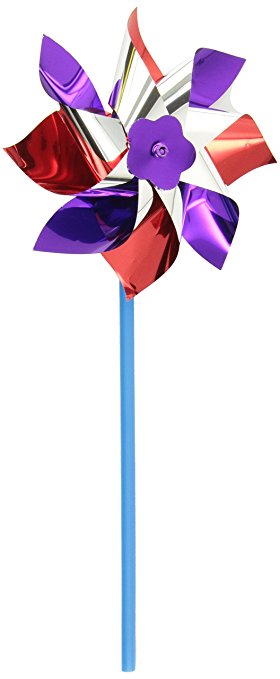
pinwheel
drinking straw
the instrument you play

[Hello! I am a broken record. Air moves out and form follows function.]

A companion to this post, a video breaking down internal and external approaches to embouchure formation, is on its way shortly. Now go move some air!


The Science is Real: Attentional Focus and Motor Skill Learning

My students are well aware that I am not a teacher of ‘technique’ per say; I won’t tell you how to set up your embouchure or what you should do with your slide. You won’t hear me tell you how to tongue or make you do fancy high range exercises. Instead, I’ll direct your attention to the flow of your air through the horn, or the shape of the phrase and where the notes want to go. I’ll make you sing a note or spin a song on a pinwheel. You’ll have to know the words (or make up your own) to a particular tune.

No technique was ever arrived at without a musical reason for doing so. -Jan Kagarice

I’m proud to say that 100% of my students make a beautiful tone on their instrument, and can answer the question, ‘what is the phrase here?’. They can all play some level of tune by ear and are learning how to improvise and compose. A student last week, who has been with me since the spring, marveled at how easy a fast passage was. “I’ve never been able to play fast,” she said. “But I’m playing fast here and I didn’t even think about it.” (Then we both got a little teary and grinned at each other for a minute)

This probably isn’t news to many teachers- putting a student’s attention on an effect or ‘external focus’ is almost always more productive and longer-lasting than directing the focus inward, to what the movement is. The good news out of science is that we have concrete evidence to prove this.

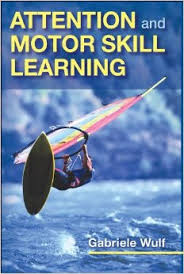
Attention and Motor Skill Learning, Gabriele Wulf

Here’s a book I want to recommend to all my teaching colleagues, no matter what your field of education. While it’s based on studies and scientific analysis, it’s easy to read and offers practical suggestions on the implementation of her findings. I’ve highlighted the heck out of my copy. At its most basic, the evidence shows that directing learners (at all levels) to the effect of their movement (external focus), rather than the movement itself (internal focus), has both more immediate and long-term results on the efficiency and accuracy of the skill.

Here are some of the points that hit home for me:

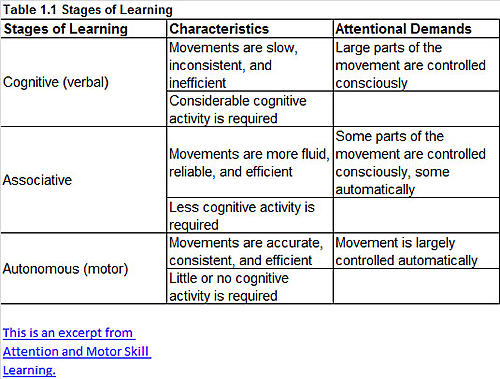
  • Learning can be divided into 3 stages: Cognitive/Verbal, Associative, and Autonomous. It’s long been assumed that we have to, at early stages in our learning process, direct attention to our movements and technical execution. As we increase in ability, our movements have more autonomy and we can focus on the results.

Internal Focus in music learning: Beginner brass players are often told to put their “lips together as though they were saying the letter ‘m'” and to “blow fast air to push the lips apart”. They are also often told to shift their instrument or lip position, or adjust their jaw or facial muscles in order to achieve different ranges. As skill increases, theoretically these instructions can be lessened, but even at my advanced level I have had teachers give me advice on how to manipulate my body to achieve a certain result.

External Focus in music learning: Lip-reed instruments like brass and some woodwinds operate on columns of air. Beginner students in my studio (as well as all other levels) are instructed to leave their lips open and flexible, place the instrument on their mouth where it feels comfortable, and move air through the tube and out past the bell. Then, they are given a pitch to imitate (and asked to sing it first), and are told to hear the instrument making that sound, and allow their lips to vibrate with the air column. It make take some trial and error, but most students get it within a few minutes with minimal effort.

  • Learning by external focus enhances not only immediate skills, but also holds up in retention tests and under performance conditions. Anxiety can cause performers to shift to more internal foci, thus causing less fluent actions. And the body cannot learn efficiently under pressure- it must have the ability to focus on one external point related to the skill in order to gain the effects of the function.

Internal Focus in music learning: We spend our precious energy practicing out of technical etude books, looking for the newest ‘hot tip’ on increasing our range, buying expensive toys that are supposed to make things more ‘natural’, and in general obsessing over HOW we do what we do, and not WHY we do it. We think about having enough air, or if we’re moving our slide fast enough, and we practice those things. Often in performance, we’ll get anxiety about the very things we’ve been drilling ourselves on, and choke in the moment.

External Focus in music learning: By adopting external foci, we are in effect ‘practicing performance’. We’re looking for the results of our actions, and utilizing trial and error to let the body adapt its own mechanisms for implementation. Instead of trying to ‘take a big breath’, we might instead sing through a phrase and see where it wants to go, and make our air stretch to that point. Instead of ‘moving the slide faster’, we might train ourselves to react to what the tempo requires us to do through incremental practice (setting a metronome at a slow speed, hearing the phrase done cleanly on a piano or voice, and then imitating. Once efficient, raise tempo a small degree of beats, rinse, repeat). In practicing performance, we are always ready to perform and we feel relaxed and comfortable in our ability to do so.

  • Feedback is only effective if it induces an external focus of attention. Feedback that highlights particular movements can be detrimental to the learning process, producing what Wulf names “maladaptive short-term corrections”, i.e. focusing on one part of the movement skill obsessively, and blocking out all other details. However, externally-focused feedback, and observational practice, can offer great insight into how to perform a skill effectively.
  • The distance of the external focus can have an effect on the learning outcome. For beginners, it may still be close to the body (for a golf club swing, thinking about the movement of the club) that then increases to a more distant goal (where does the ball need to go) as the skill develops, but the focus is still outside of specifying bodily movements.
  • External focus cues result in more efficient and technically accurate movements. A study using electrode analysis of the muscle movements on participants doing bicep curls had two groups of learners: those thinking about the movement of their arm (internal) and those moving the bar in a certain way (external). The analysis showed that the external group used far less muscle movement to execute the skill, wasting less energy and learning the technique more quickly and with less effort.

Internal Focus in music learning:  “Tighten your corners for that high note and blow faster air”- over-utilizing muscles that already have to take on a certain amount of pressure to play a higher note, adding stress and tightness and creating disappointing results.

External Focus in music learning: “Sing the note. ‘Play’ the note on a straw or pinwheel. Focus on the sound and resonance of the bell as you go higher.” Often its easiest to help students with range by assigning them a simple tune they know that can be transposed into different ranges to help them hear higher or lower notes. Their body will adapt the correct amount of pressure and lip aperture automatically, and learn intrinsically how to maneuver the speed of their air.

  • Learning by external focus is a relatively general phenomenon. Different types of learners (kinetic, visual, etc) show no variation in how effective external attention is on gaining motor skill confidence. People who suffer stroke, speech impediments, Parkinson’s Disease, and other neurological conditions have shown tremendous improvement utilizing external attentional focus. Children can benefit especially, as picking up a skill is no longer a matter of boring task-specific instructions, but instead can unlock abilities through their natural learning process.

Conceive, don’t perceive. -Arnold Jacobs

Even without the scientific evidence to back it up, I would still teach this method. Learning this way of thinking changed my entire approach to the trombone, and I credit the shift with why I am still performing and teaching today. I see the results every day in my students, and I am always adapting to their current needs while keeping their ‘ear on the prize’. And I believe it’s the most egalitarian way we can educate- not stifling learning processes with too much noise and information, not creating barriers for learners who might not be engaged by or capable of long hours of technical work, not holding any biases as to ‘who can do what’ (“you have big lips! you can be a tuba player” or “you’ve got a big set of lungs for a little lady”)- but instead knowing that every individual is capable of playing an instrument, if only we allow them to learn naturally and freely.

Lauren’s System for Stress-less Freelancing

One of the things I love about summer as a freelancing brass musician is the renewed influx in gigs spanning many different musical genres other than classical and art music. But summer can also bring with it lots of ‘freebies’ and ‘exposure-generators’ that don’t do much for career or enjoyment. Because of this I have a (year-round) system for accepting gigs that has contributed immensely to my well-being as a musician and human being.

Introducing my “System for Stress-Less Freelancing”- a simple formula that will help you work while you create your art and create your art while you work.

Gigs generally fall into one or more of the following 3 categories:

  1. Offers fair compensation for your time and skills
  2. Is artistically valuable to you in some way (i.e. good or unique repertoire, challenges or refines your skill sets, is enjoyable to perform)
  3. Gives you the opportunity to work with people you value and/or like as people and musicians

If a gig can offer you at least 2 of these categories, it’s worth considering. If it’s just one- or none- well, you might find it’s not the gig for you.

Sometimes a gig just pays, and pays well, and in that case it might be a good thing to take it and use that financial freedom to take a ‘riskier’ gig down the road that you really want to do or offers you a new experience. But it’s likely that even if it seems like it just pays well, it probably also affords you networking opportunities or is a resume-builder. You also never know who you’ll reach with the communication you offer through your art. That said, remember that you’re in charge of keeping your musical soul healthy, and too much of just ‘work’ can really dull the joy of making music.

Being an artist isn’t just a job. If it’s starting to feel like one, take a step back. Maybe putting a few ground rules to what you say yes to will help you find the opportunities that really make you sing.


Conceptual Desire Paths and the Modern Musician

Many of my students know that I’m big fan of podcasts, and one of my absolute favorites is the design-focused program 99% Invisible. The shows are usually about 25-30 minutes long and cover all number of topics from architecture and city planning to the everyday objects you use and broad societal concepts that have been designed into our lives. It’s a brilliant show and it’s opened my eyes to so many new ideas and patterns in our world.

One of the latest episodes, a sort of compilation story they do every now and again with shorter ideas that can’t make up a full episode, introduced me to the concept of desire paths.

A desire path (formally referred to as desire line in transportation planning, also known as a game trail, social trail, herd path, cow path, goat track, pig trail or bootleg trail) can be a path created as a consequence of erosion caused by human or animal foot-fall or traffic. The path usually represents the shortest or most easily navigated route between an origin and destination. – Wikipedia

Of course we see (and use!) these everywhere, but I had no idea they had a name. The concept sat with me a few days, percolated, occasionally surfaced in real life (I cut across grass yesterday while gleefully bubbling a little ‘desire path!’ tune), and then suddenly came crystal clear as the description I’ve needed all along for how I’ve built my career and life.

Our lives are desire paths. We shape our careers, relationships, lifestyles, homes by shortcuts (and longest) to the most efficient or desirable ways of being ourselves.

Musicians trying to make a name these days are learning this the natural way- understanding how to navigate a changing field and career market and make an impression in the best manner possible. We have an industry structure: 1. Practice hard 2. Win a gig 3. Success, but we’re realizing more and more that that serves a distinct and small part of our musical population, and the opportunities to follow this path are not available to everyone. The rest of us can either quit in frustration, stymied by a metaphorical sidewalk that doesn’t go the way we want it to, or walk around it, making our own path.

My desire paths as a musician include:

-Seeking out effective resources to help me build a teaching studio and to teach effectively and inspirationally; developing my teaching philosophy (stay tuned to see that in writing, finally!); expanding my outreach and values geographically to the people who are ready to receive it

-Building a list of skilled and competent musicians (with a strong focus on women and/or performers of color) from which to build my community; finding my audience and incorporating it into that community

-Choosing the gigs I want- and developing the skills for them- carefully; being consistent with the image I want to portray and the healthy career/life balance I strive for: changing the ways in which the embedded musical concepts of ‘industry standard’, ‘authenticity’, and ‘virtuosity’ affect my mindset and my performance and taking only what is valuable

What are the ways you’ve incorporated metaphorical desire paths in your career and life? What ways can you see yourself trying new directions in the future? How can you help someone else navigate their own desire path? Let’s redesign this business, one dirt track at a time.

IWBC Recap

Last week I was able to attend the International Women’s Brass Conference for the first time, and it was an experience of a lifetime.  In a nutshell, I met some of my heroes, made some new ones, connected with old and new friends, competed against some top-class performers (3rd place- not too shabby!), heard amazing performances by individuals and groups alike. Here’s a little breakdown of what I took away:

Day 1

  • Prelims for the solo competition- I performed movements I and II of the Rota Concerto and was awarded 3rd place for my age category.
  • Heard soloists Ashley Hall, trumpet, and Velvet Brown, tuba, perform with the Rowan Uni wind ensemble, helped honor the conference’s Pioneer Award winners
  • At the opening reception, met and talked with one of my inspirations, Abbie Conant, and worked hard to stay collected and calm. 🙂

Day 2

  • Recitals by Natalie Mannix and Ava Ordmann, trombones (all music by female composers!), and Donna Parkes, trombone (AMAZING rendition of the Sulek)
  • panels by Debra Taylor (on focal dystonia and recovery) and Stacie Mickens (on practice habits and tricks)
  • evening performance by Athena Brass Band (new life goal: get in this ensemble!), an all-female British-style brass band.

Day 3

  • Panels on Alexander Technique with Lori Schiff (Julliard School) and racism in the music world with Marquita Reef (St Louis educator)
  • Recitals by Julia McIntyre, bass trombone (some of the loveliest playing I’ve heard in a long time), and Ashley Hall, trumpet (incredible sounds!)
  • Heard my dorm-mate Kaitlin rock her finals performance for the competition
  • Played duets out of my new duet book with Gabe
  • Knockout evening performance by DIVA Jazz Orchestra

Day 4

  • Panels: “Who Gets the Gig”- social psychology and music by Maureen Hogan, Georgia Tech, and “Entrepreneurship” with several working musicians in different fields
  • Jeannie Little, trombone, presented a lecture-performance on the Tomasi Concerto and the influence of Tommy Dorsey- her performance of the Tomasi was superb.
  • Recital performances by Velvet Brown (MOJATUBA- with dance and percussion), and JAM- Joanna and Michael (tubaeuph/cimbasso duet)
  • Final evening performance from Monarch Brass, the signature group of the IWBC. Such. Sounds.

Some slight organized thoughts:

  • It’s so inspiring to see all these women working at a high level. Meeting the heroes of the earlier generation and mingling with those of mine- it’s great to see how far we’ve come
  • That said, we have ages to go. The competitions, open to all genders, were mostly won by men. I have thoughts about how they could be structured different, but in the meantime- what will it take to get women into those winning spots more frequently? Is it confidence? Training? Access?
  • I would like to see more rest/social time built into the conference schedule. It was jam-packed, and everything was interesting, so we were exhausted at the end of each day.
  • I would also like more time to play and network with my colleagues. Reading sessions with all the trombones, or ad-hoc brass quintets. Anything to get us out of our cliques and talking to new friends.
  • The conference, like much of the music industry, is still very ‘job-oriented’, focused on winning that orchestra job or finding the tenure-track college position (that will disappear in the next 10 years anyway). I wanted more from freelancers, non-conventional performers, and educators building careers in their communities using all the strategies available to them. How does the younger generation find work in a changing economy? How do we all stay happy and healthy as musicians, whether we’re top dog or working like one?

All in all, it was a week to remember. I’m so grateful for the opportunity to have gone, to have had the chance to compete, and to make new connections. I’ll have lots to sustain me for the next few months, and I’ll be back for the conference at ASU in 2019 (hopefully with my own panel/performance, and with Brass Lassie in tow!)!

Lauren at IWBC!

I’m very excited to be traveling to Glassboro, New Jersey, this week, to attend the International Women’s Brass Conference! My friend Gabe Mueller will be joining me, and we both plan to compete in the Susan Slaughter Solo Competition, as well as attend workshops, performances, and clinics throughout the week.

Some of my lady brass heroes will be attending as well, such as pioneer trombonist Abbie Conant and the DIVA Jazz Orchestra.

Watch this space and my Facebook page for updates throughout the week!

Summer is upon us!

Students, friends, family, and fans,

Summer is in the air and it’s time for an updated lesson schedule as well as info on upcoming gigs and performances!

If you are a student or a potential student, make sure to check out my Summer Schedule for lesson availabilities.

I also will keep my Performance Calendar updated as the summer goes on. Upcoming gigs include a stint on bass trombone with the Swing Sisterhood and Brass Lassie’s first summer show at the Normandale Lake Bandshell in Bloomington.

Brass Lassie will be very busy this summer, performing at the State Fair, the MN Irish Fair, and the Vintage Band Festival in Northfield! I hope you can make a performance.