Weekly Round-up 4/4/16

Performances: Metro Brass 5/1/2016 Live at the Capri Theatre. Tickets are on sale now!

I’ve got upcoming masterclasses and performances with Mill City Five and The Satellites in May coming up quick!

Rehearsals: No rehearsals this week.

Practicing: Minnesota Orchestra opened up a substitute low brass audition! It’s April 25th and I’m hard at work preparing Valkyries, William Tell, Mahler 5, Bolero, Mozart, all the old chestnuts.

Listening: Phosphorescent Blues by The Punch Brothers came back up in my rotation this week. Such a gorgeous album.

Teaching: It’s been a light week for teaching as many of my students were on spring break. I’m hoping to take that rest into this week’s lessons and give some new energy to my talented students.

Studying: “SuperTeaching” by Eric Jensen. Feeling like I need to up my game for my lovely students. Trying to get my hands on a copy of Attention and Motor Skill Learning by Gabriele Wulf.

Relaxing: Eloise Butler Wildflower Garden, my favorite place in Minneapolis, opened on Friday! I rode my bike over today and enjoyed the sunshine.

Metro Brass at The Capri: Tickets now available!

A special announcement today: Tickets are now on sale for the feature Metro Brass performance at the Capri Theatre in N Minneapolis!

Details:

Hold on Tight! An Evening with Metro Brass

Sunday, May 1, 2016 at 7pm

Capri Theatre, 2027 W Broadway Ave, Minneapolis 55411

Facebook event page

Tickets $12 adv/$15 door 

We’re playing an exhilarating program of swing classics, Latin and Spanish melodies, and yes, even Bill Chase. Hope to see you there!

Women’s History Month 2016: The Girls in the Band

In celebration of tonight’s premiere Swing Sisterhood concert, the final WHM2016 post today is dedicated to those female musicians throughout jazz history who deserve their due, even if history obscured them.

Last year I covered Melba Liston‘s incredible influence on jazz trombone. But she wasn’t the only female musician making waves in the jazz era. Groups like The International Sweethearts of Rhythm, Lil-Hardin’s All Girl Band, Lena Kidd Quartet, and Ivy Benson and Her All Girl Orchestra played with skill and swing.

While it may have been seen or imagined as a publicity schtick, all-girl orchestras provided (and continue to provide) a place for talented musicians to come together and perform in an industry that shunned them otherwise. If they weren’t singers or pianists, women musicians didn’t have much of a shot in the jazz world. On top of that, female musicians playing in male majority bands faced harassment, discrimination, and worse.

http://jazzhotbigstep.com/170.html
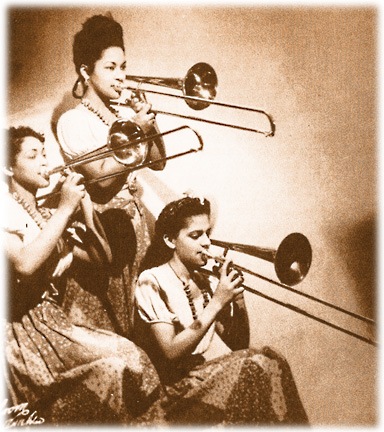
International Sweethearts of Rhythm Trombone section. Credit: http://jazzhotbigstep.com/170.html

The International Sweethearts of Rhythm have been widely considered one of the highest quality all-female bands in jazz history. They broke racial barriers, set jazz sales records, and helped celebrate the end of World War II in Paris with the troops. They were largely erased from history until the 1970s, when their contributions to women at work in traditional male fields became a source of study for women’s history departments.

One of my responses to ‘it’s not every day you come across a working female trombone player’ is ‘it’s not every day we get the recognition we deserve’. History is written by the victors, and for millennia, patriarchy has been winning. Because we don’t see women working in certain fields does not mean they do not exist. Representation and recognition are key to giving women, people of color, and non-binary and transgender folks their due in a world often hostile to their success. Next time you see a hard-working female musician out at a gig, consider that she may not want to be singled out for her gender alone. Give her a compliment on her musicianship. Thank her for her example. Give the girls in the band their due.

Sources for this post: Women of Jazz, All Female Bands of the 20th Century, The Girls in the Band (documentary), America’s “Sweethearts” (NPR story)

Weekly Round-up 3/28/16

Performances: Saturday: Hamline Winds in concert at Sundin Hall! 7:30pm on Hamline University Campus. I’m sitting in as player-coach this semester and enjoying every minute.

I’ve got upcoming masterclasses, performances with Mill City Five and The Satellites, and a big concert planned with Metro Brass upcoming in April and May.

Rehearsals: MC5 meets Wednesday night, Metro meets Sunday- we’re gearing up for spring and summer gigs!

Practicing: Now that Easter is over and spring break has begun for many of my students, I’m looking forward to diving into some new music this week. I’ll start the 3rd movement of Red Dragonfly and I hope to learn most of the 1st movement of the Bourgeois Concerto.

Listening: Podcasts. Still lots and lots of podcasts.

Teaching: I’m refining my method for teaching the natural approach every day. This week, with a little more free time, I’m hoping to deepen my understanding of how our focus controls our product. I’m also making efforts to listen more carefully to what my students are telling me, both explicitly and implicitly.

Studying: “SuperTeaching” by Eric Jensen. Feeling like I need to up my game for my lovely students. Trying to get my hands on a copy of Attention and Motor Skill Learning by Gabriele Wulf.

Relaxing: It’s (mostly) spring break! Bike rides, walks, talks with friends, naps all on the list.


Women’s History Month 2016: Poster Girls

(Previous WHM2016 posts: NUNS!, Courtly Ladies)

This week in Women’s History Month, it’s time to break down how women have been represented in art across Western history with instruments, and in particular, brass instruments.

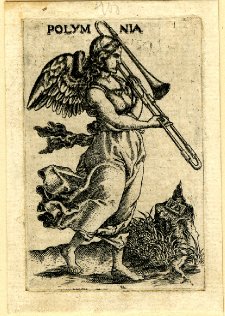
In many cases, women holding trombones and cornettos in early art history are depicted as muses, angels, or mythological figures, and it is uncertain whether the models come from real-life inspiration.

Trombonist as Muse

credit: Will Kimball

Here we see Polyhymnia, muse of sacred poetry and hymns, in her natural element as trombone player. This is from a series of engravings done by Franz Brun in the 1570s depicting all nine muses (1). Why would Brun choose to give Polyhymnia a trombone? At the time, trombone served a significant role in church ensembles, providing a strong compliment to vocal lines that in larger groups imitated the sound of organ. Even as it blended well with vocal lines and organ accompaniment, it did not obscure text or meaning in the way other instruments’ textures might, and was seen as a way of enhancing spiritual communication (2). Thus, our muse of sacred poetry and hymns would know her way around a trombone, the literal muse of the religious world.


Weekly Round-up 3/21/16

Happy Spring!

Performances: Easter Services at Bethlehem Lutheran in S Mpls on March 27th are the next thing up for now! I’ve got upcoming masterclasses, performances with Mill City Five and The Satellites, and a big concert planned with Metro Brass upcoming in April and May.

Rehearsals: Metro meets twice this week in preparation for our May 1st concert at the Capri Theatre in North Minneapolis. Stay tuned for more details on that- we were sounding great last night and this should be an exciting program!

Practicing: All the tunes (and new potentials) on my Tune Library!

Easter gig music has some doozies in it (including an arrangement for BQ of the Hallelujah Chorus from Messiah). Should be fun, but it’s going to be a long morning and I need to make sure I’m in shape for it!

Listening: Podcasts (Radiolab, You Made It Weird, 99% Invisible, My Brother, My Brother, and Me)

Teaching: Tunes, continued. Plus, a new approach to our normal breath warm-up/exercise. If you haven’t gotten that from me yet, you will soon!

Studying: “SuperTeaching” by Eric Jensen. Feeling like I need to up my game for my lovely students.

Relaxing: A little weekend trip to Cedar Rapids, IA, for fun and maple syrup. It was a whim and a good one!


Women’s History Month 2016: Courtly Renaissance BrassChix

This is the second installment of Women’s (Brass) History Month 2016. See here for previous posts.

This week, let’s take a look at what role women musicians had in the courts of the Renaissance, and in particular, shift our focus to the music-mad court of 1590s Mantua, where Duke Vincenzzo I cultivated a lively court. He paid lavishly for his female singers, asking his musical director, Claudio Monteverdi (yes, that Monteverdi), to find the best (and cheapest, apparently) performers to entertain him (1).

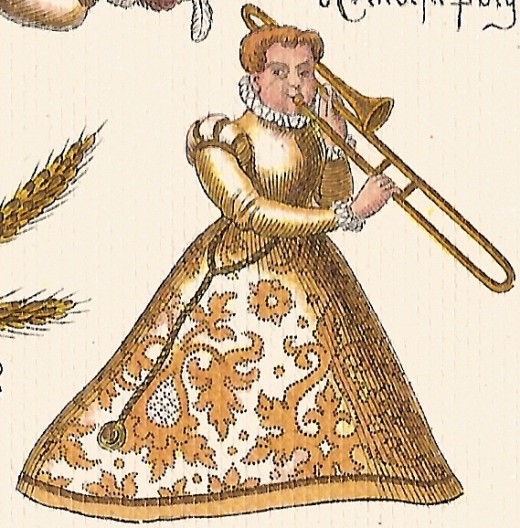
Among the roster of musicians in the register, two sisters, Lucia and Isabetta Pelizzari, appear as singers and instrumentalists in their father’s family band. The instruments they mastered? Cornetto and trombone (2). The Pelizzari family likely was middle-class, solidly placed enough to justify musical education for all their children, but not nobility, for whom giving a woman a brass instrument to blow into would have been an unsightly disgrace. Such a family would need all capable bodies to lend their talents to the business. They made their living from their craft, and they delivered it well. By all accounts, women in Italy had risen above courtier status (trained musicians whose education was intended to give them access to higher courts and power) and emerged as regarded performers in their own right (3).

Many female musicians are listed in the books of Italian Renaissance courts, mostly vocalists who would accompany themselves on lute or harp, but Lucia and Isabetta surely set a precedent for aspiring performers going into the 17th century. There was already a strong tradition of portraying women holding all variety of instruments, including sackbut, in works of art depicting the muses and other mythological scenes. It’s not a far leap to guess that women saw themselves represented in art and thought, “I ought to give that a try.”

7184719_f520

Image: Detail of a tablecloth featuring musicians (both male and female) in the court of a German duke. 1560s.

Weekly Round-up 3/14/16

Happy Pi Day!

Screen Shot 2016-03-14 at 2.00.11 PM

Performances: Easter Services at Bethlehem Lutheran in S Mpls on March 27th are the next thing up for now! I’ve got upcoming masterclasses, performances with Mill City Five and The Satellites, and a big concert planned with Metro Brass upcoming in April and May.

Rehearsals: Mill City Five is jamming on Wednesday night. Metro meets Sunday.

Practicing: All the tunes (and new potentials) on my Tune Library!

Listening: Podcasts (Radiolab, You Made It Weird, 99% Invisible)

Teaching: Tunes!

Studying: Focus and anxiety release.

Relaxing: I took naps yesterday. It felt nice.


Lauren’s Comprehensive Crowdsourced Tune Library

Friends, Colleagues, and Students! You know by now that I’m a big advocate for playing tunes by ear, in all keys, to help develop sound, phrasing, musicality, intonation, range, technical ability, dynamic contrasts, theory skills, composition and analysis– jeez, is there anything tunes CAN’T do for your musical progress?

Well, oftentimes I come up at a lack for a tune to do or I’ve done the same few for several weeks and need something new. Or, a student might need a new tune and wants something up a level, or in a different meter, you name it. Yesterday morning I started making a list of simple tunes.

By afternoon I’d created a whole spreadsheet detailing each tune’s level of difficulty, range, meter, tempo, style, and basic technical considerations. And then I shared it as a collaborative link.

Collaborative Tune Library

How to use the document: 

1. Decide what level of tune you want to try (easy- basic intervals and key; medium- some altered tones, bigger range; difficult- modulations, technical passages, long phrases) and what technical considerations you might want to involve (range, dynamics, articulation, etc), and pick a tune accordingly.

2. Decide what key is easiest for you to start in. If you are looking to work on higher register tones, start in a key where the tune’s highest note is in your comfort range, then transpose the tune upward by half steps until you reach the range you want to improve. This can be done in the opposite direction for low range. You can move around the circle of fifths, also.

3. Find a good tempo for you to learn at, and set your metronome.

4. Put a drone track (free mp3 download) to your first key. Headphones are best for this, unless you have a quality sound system. Make sure you can hear both the drone and your own sound.

5. Play that tune!

How to add to this document:

1. Open it.

2. Make sure the tune you want to add isn’t already on it.

3. Add your tune and all the relevant details. Feel free to add comments about why you like it or how it helps you.

4. Repeat with another tune!


Women’s History Month 2016 – Brassy Ladies Through the Ages

Welcome to another Women’s History Month, and as a bonus, Happy International Women’s Day!

Last year, I took a look at five different women who made or are making waves as brass musicians: Melba Liston, Megumi Kanda, Velvet Brown, Lauren Vernonie Curran, and Jan Kagarice.

This year, inspired by yet another comment at a concert along the lines of “there sure aren’t many female trombone players”, I’m going to give four short history lessons on the importance of women to brass performance through the ages. Let’s get started!

Installment Number One: Get Thee to a Nunnery!

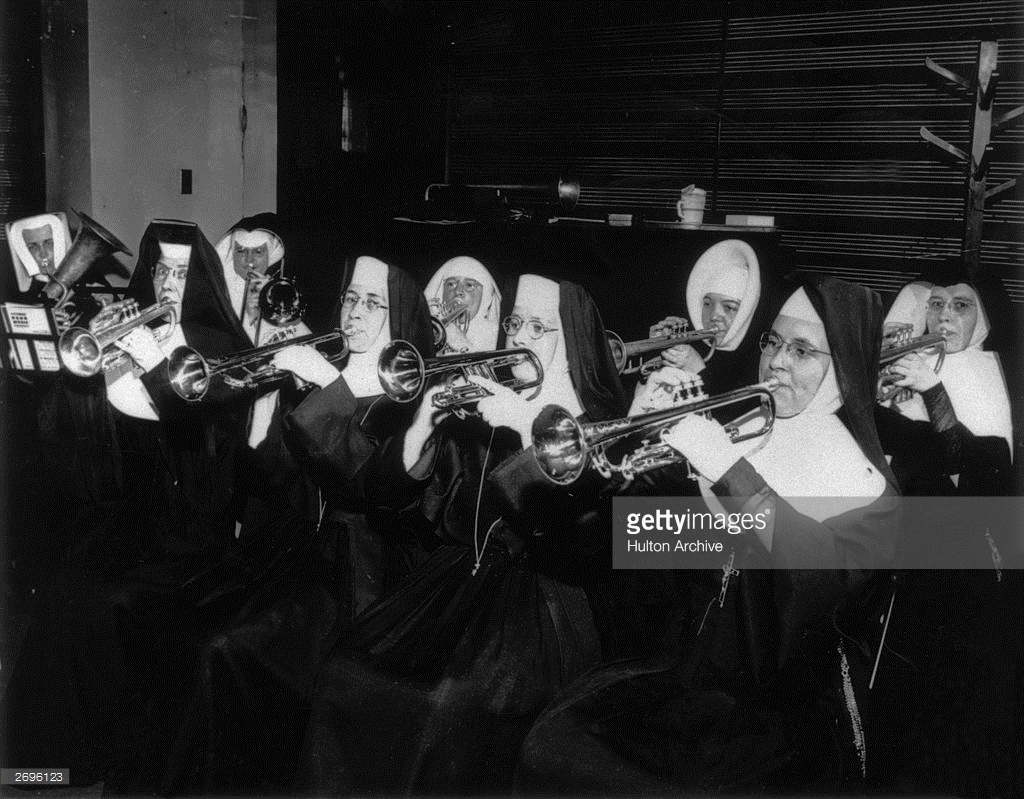
Western music tradition as we know it today is a direct product of centuries of experimentation and development by none other than European religious orders. Monks and nuns throughout the Middle Ages composed, refined, and performed sacred works whose practice would come to define classical theory. It should be no surprise to us to learn, then, that instruments of all sorts were being played in convents across Europe, despite the Catholic Church’s decree that women should not play wind instruments. Nuns have always been pretty rebellious and evidence out of Italy suggests that some of the sisters were talented cornett and sackbut players. Speculation has it that an absence of male voices in the convent choir would lead to a need for lower voices, and what better choice than a trombone?

Says Bottrigari of the nuns of the San Vito convent:

“[the nuns play] cornetts and trombones [cornetti & tromboni], which are the most difficult of musical instruments….with such grace, and with such a nice manner [con tanta gratia, & con si gentil maniera], and such sonorous and just intonation of the notes that even people who are esteemed most excellent in the profession confess that it is incredible to anyone who does not actually see and hear it. And their passagework is not of the kind that is chopped up, furious, and continuous, such that it spoils and distorts the principal air, which the skillful composer worked ingeniously to give to the cantilena; but at times and in certain places there are such light, vivacious embellishments that they enhance the music and give it the greatest spirit” (Bottrigari-MacClintock 59; Bottrigari 49)

(Source)2696123

Looks like things haven’t changed much. Keep up the good work, sisters!