Upcoming Presentations!

Two really exciting things in January:

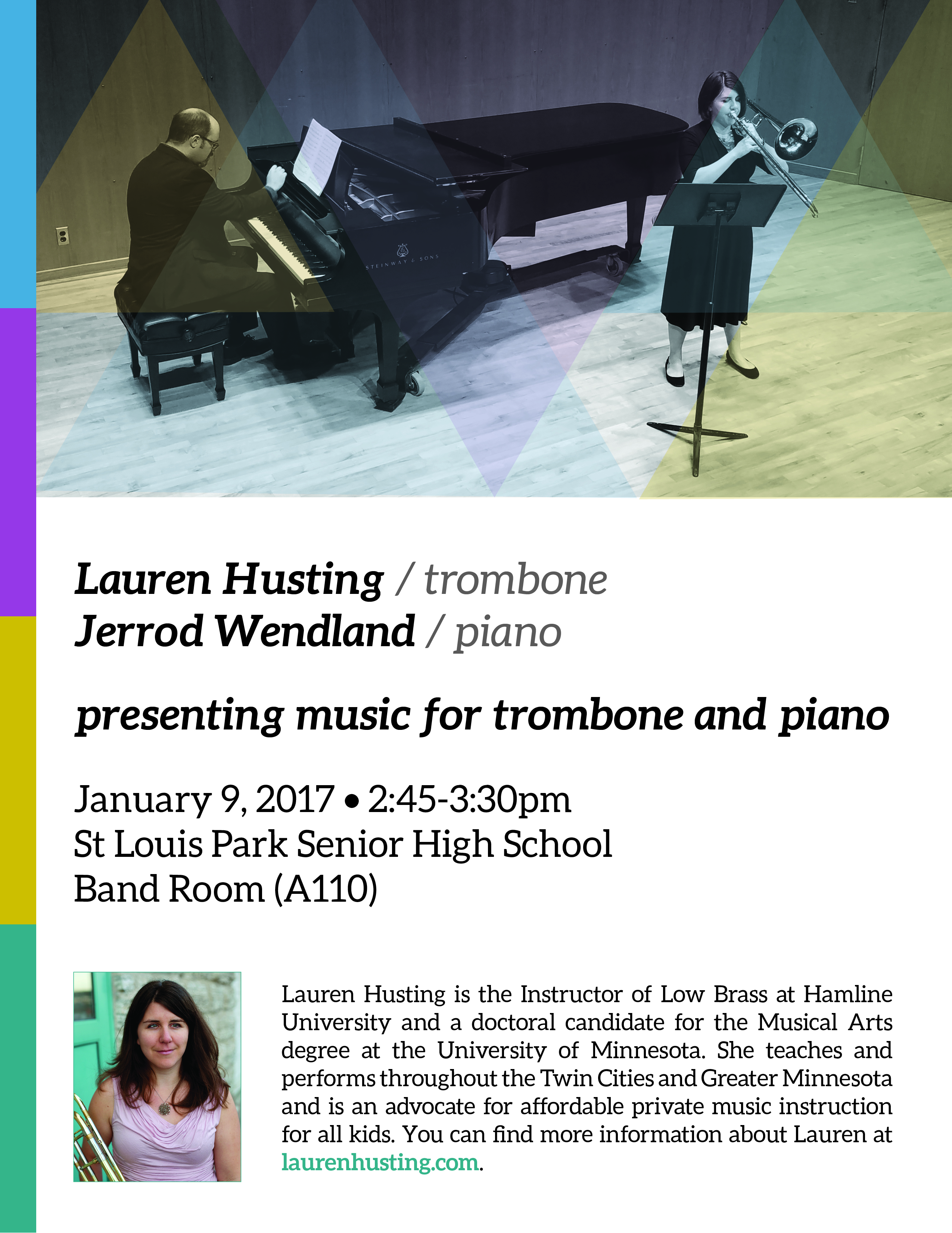
lauren-husting-flyer

My performance at St Louis Park Senior HS, featuring selections from my December 2016 doctoral recital, is presented in part by the generous contributors to my Studio Scholarship Campaign. As you recall, the fund exceeded its goal and I allocated $300 to presenting clinics and performances in local schools. This is the first opportunity I’ve had to use this money, and if you’d like a performance at your school, please reach out to me!

At the end of January, BrassChix soars again! This is my 4th (or 5th?) year presenting for BC and I’m so excited for this year’s theme: How LOW Can You Go? We’ll be focusing on our sisters of low brass and the lowest notes from every horn.

All the info: BrassChix 2017


Scholarships!

I still have room in my scholarship budget for new students. If you are a low brass player who couldn’t otherwise afford lessons without financial assistance, but feel you would benefit from them, please visit my Scholarship Application page for details.

Women’s History Month 2016: The Girls in the Band

In celebration of tonight’s premiere Swing Sisterhood concert, the final WHM2016 post today is dedicated to those female musicians throughout jazz history who deserve their due, even if history obscured them.

Last year I covered Melba Liston‘s incredible influence on jazz trombone. But she wasn’t the only female musician making waves in the jazz era. Groups like The International Sweethearts of Rhythm, Lil-Hardin’s All Girl Band, Lena Kidd Quartet, and Ivy Benson and Her All Girl Orchestra played with skill and swing.

While it may have been seen or imagined as a publicity schtick, all-girl orchestras provided (and continue to provide) a place for talented musicians to come together and perform in an industry that shunned them otherwise. If they weren’t singers or pianists, women musicians didn’t have much of a shot in the jazz world. On top of that, female musicians playing in male majority bands faced harassment, discrimination, and worse.

http://jazzhotbigstep.com/170.html
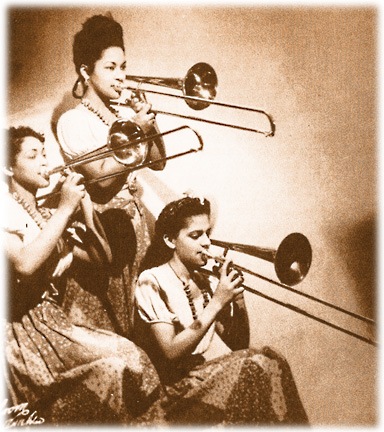
International Sweethearts of Rhythm Trombone section. Credit: http://jazzhotbigstep.com/170.html

The International Sweethearts of Rhythm have been widely considered one of the highest quality all-female bands in jazz history. They broke racial barriers, set jazz sales records, and helped celebrate the end of World War II in Paris with the troops. They were largely erased from history until the 1970s, when their contributions to women at work in traditional male fields became a source of study for women’s history departments.

One of my responses to ‘it’s not every day you come across a working female trombone player’ is ‘it’s not every day we get the recognition we deserve’. History is written by the victors, and for millennia, patriarchy has been winning. Because we don’t see women working in certain fields does not mean they do not exist. Representation and recognition are key to giving women, people of color, and non-binary and transgender folks their due in a world often hostile to their success. Next time you see a hard-working female musician out at a gig, consider that she may not want to be singled out for her gender alone. Give her a compliment on her musicianship. Thank her for her example. Give the girls in the band their due.

Sources for this post: Women of Jazz, All Female Bands of the 20th Century, The Girls in the Band (documentary), America’s “Sweethearts” (NPR story)

Women’s History Month 2016: Poster Girls

(Previous WHM2016 posts: NUNS!, Courtly Ladies)

This week in Women’s History Month, it’s time to break down how women have been represented in art across Western history with instruments, and in particular, brass instruments.

In many cases, women holding trombones and cornettos in early art history are depicted as muses, angels, or mythological figures, and it is uncertain whether the models come from real-life inspiration.

Trombonist as Muse

credit: Will Kimball

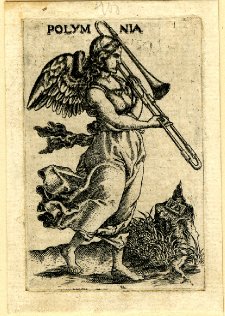
Here we see Polyhymnia, muse of sacred poetry and hymns, in her natural element as trombone player. This is from a series of engravings done by Franz Brun in the 1570s depicting all nine muses (1). Why would Brun choose to give Polyhymnia a trombone? At the time, trombone served a significant role in church ensembles, providing a strong compliment to vocal lines that in larger groups imitated the sound of organ. Even as it blended well with vocal lines and organ accompaniment, it did not obscure text or meaning in the way other instruments’ textures might, and was seen as a way of enhancing spiritual communication (2). Thus, our muse of sacred poetry and hymns would know her way around a trombone, the literal muse of the religious world.


Women’s History Month 2016: Courtly Renaissance BrassChix

This is the second installment of Women’s (Brass) History Month 2016. See here for previous posts.

This week, let’s take a look at what role women musicians had in the courts of the Renaissance, and in particular, shift our focus to the music-mad court of 1590s Mantua, where Duke Vincenzzo I cultivated a lively court. He paid lavishly for his female singers, asking his musical director, Claudio Monteverdi (yes, that Monteverdi), to find the best (and cheapest, apparently) performers to entertain him (1).

Among the roster of musicians in the register, two sisters, Lucia and Isabetta Pelizzari, appear as singers and instrumentalists in their father’s family band. The instruments they mastered? Cornetto and trombone (2). The Pelizzari family likely was middle-class, solidly placed enough to justify musical education for all their children, but not nobility, for whom giving a woman a brass instrument to blow into would have been an unsightly disgrace. Such a family would need all capable bodies to lend their talents to the business. They made their living from their craft, and they delivered it well. By all accounts, women in Italy had risen above courtier status (trained musicians whose education was intended to give them access to higher courts and power) and emerged as regarded performers in their own right (3).

Many female musicians are listed in the books of Italian Renaissance courts, mostly vocalists who would accompany themselves on lute or harp, but Lucia and Isabetta surely set a precedent for aspiring performers going into the 17th century. There was already a strong tradition of portraying women holding all variety of instruments, including sackbut, in works of art depicting the muses and other mythological scenes. It’s not a far leap to guess that women saw themselves represented in art and thought, “I ought to give that a try.”

7184719_f520

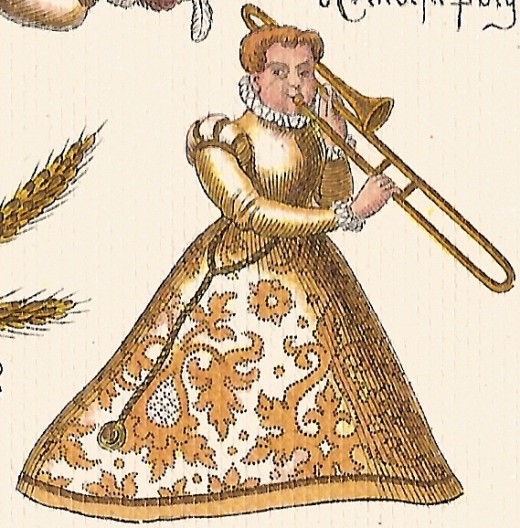
Image: Detail of a tablecloth featuring musicians (both male and female) in the court of a German duke. 1560s.

Women’s History Month 2016 – Brassy Ladies Through the Ages

Welcome to another Women’s History Month, and as a bonus, Happy International Women’s Day!

Last year, I took a look at five different women who made or are making waves as brass musicians: Melba Liston, Megumi Kanda, Velvet Brown, Lauren Vernonie Curran, and Jan Kagarice.

This year, inspired by yet another comment at a concert along the lines of “there sure aren’t many female trombone players”, I’m going to give four short history lessons on the importance of women to brass performance through the ages. Let’s get started!

Installment Number One: Get Thee to a Nunnery!

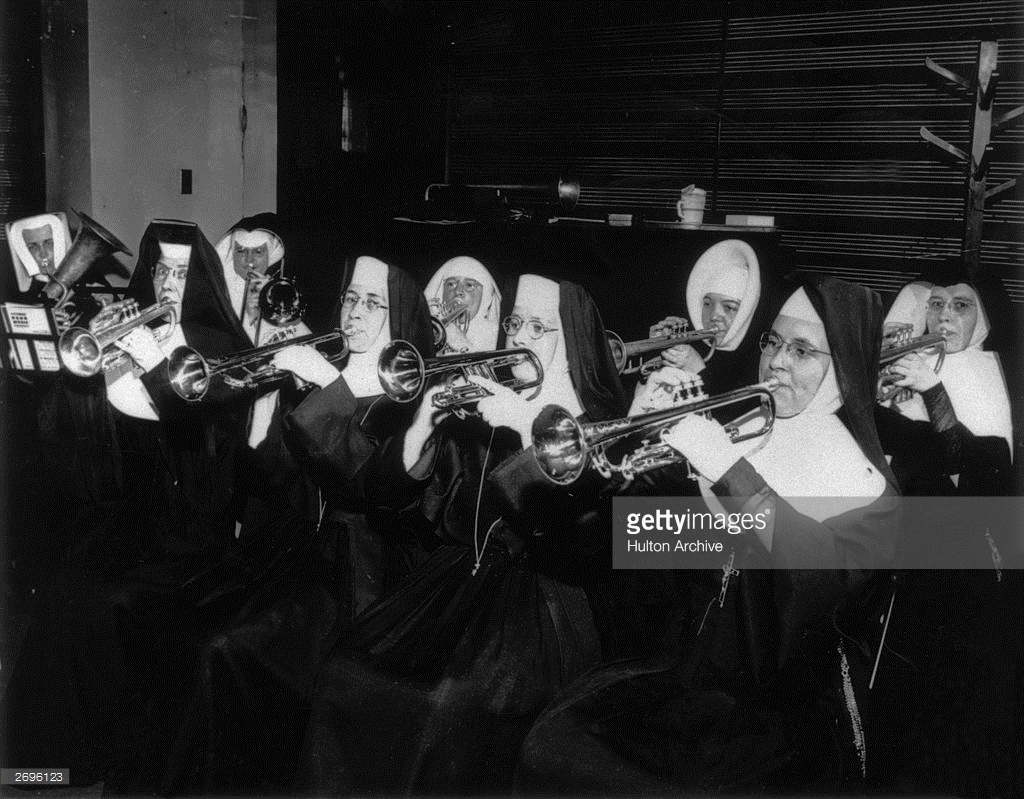
Western music tradition as we know it today is a direct product of centuries of experimentation and development by none other than European religious orders. Monks and nuns throughout the Middle Ages composed, refined, and performed sacred works whose practice would come to define classical theory. It should be no surprise to us to learn, then, that instruments of all sorts were being played in convents across Europe, despite the Catholic Church’s decree that women should not play wind instruments. Nuns have always been pretty rebellious and evidence out of Italy suggests that some of the sisters were talented cornett and sackbut players. Speculation has it that an absence of male voices in the convent choir would lead to a need for lower voices, and what better choice than a trombone?

Says Bottrigari of the nuns of the San Vito convent:

“[the nuns play] cornetts and trombones [cornetti & tromboni], which are the most difficult of musical instruments….with such grace, and with such a nice manner [con tanta gratia, & con si gentil maniera], and such sonorous and just intonation of the notes that even people who are esteemed most excellent in the profession confess that it is incredible to anyone who does not actually see and hear it. And their passagework is not of the kind that is chopped up, furious, and continuous, such that it spoils and distorts the principal air, which the skillful composer worked ingeniously to give to the cantilena; but at times and in certain places there are such light, vivacious embellishments that they enhance the music and give it the greatest spirit” (Bottrigari-MacClintock 59; Bottrigari 49)

(Source)2696123
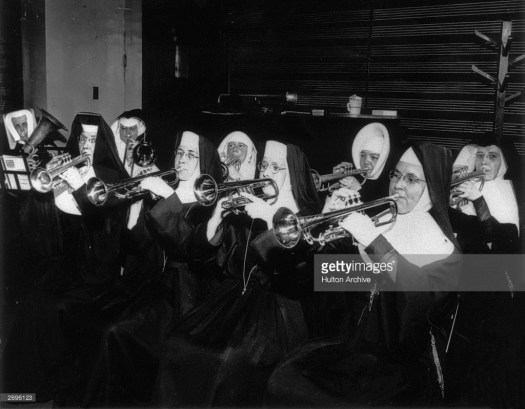
Looks like things haven’t changed much. Keep up the good work, sisters!

“Lunch With…Lauren Husting!”

You can now watch two of the pieces from my 2/8/2016 “Lunch with…” recital in Sundin Hall on Hamline University campus in convenient YouTube format!

David, Concertino (all)

Mills, Red Dragonfly (1st mvt)

My pianist is the lovely and talented Rebecca Hass.

Enjoy!

Women’s History Month Profile: Jan Kagarice

March feature! Each week I will profile a different woman or women in music who are particular heroes or inspiration for me.

This week, please welcome to the stage

MS JAN KAGARICE!

Kagarice-Jan

The goal of music is communication, not perfection.

Musician, scholar, pedagogue, force of nature, Jan Kagarice is senior lecturer of trombone at the University of North Texas. She’s taught and lectured all over the world, and was a founding member of internationally acclaimed trombone quartet PRISMA.

Jan’s teaching method focuses on methods garnered from greats like Arnold Jacobs and John Marcellus. She studies nearly everything having to do with how we learn to create a comprehensive approach. It’s all about the music, and what we say with our unique skills. 99.9% of what I tell my students comes from her. 100% of who I am as a performer is thanks to my time studying with her. It’s hard to put into words what my time at UNT meant to me, because I’m still processing so much of it. Needless to say, I wouldn’t still be working as a trombone player without the things I learned from Jan.

In addition to instilling these traits in her students, she also works with musicians affected by focal dystonia, a disorder that in the past has prevented many brass musicians from continuing their careers.

While a first-class performer herself, there’s not a lot to be found of her own recordings on the internet. What we do have, though, is a long and continuing legacy of her students whose performances speak to her enormous influence. Please enjoy my favorite trombone quartet, Maniacal 4, performing a piece written for Ms Kagarice, “Janet”.


Women’s History Month Profile: Lauren Veronie Curran

March feature! Each week I will profile a different woman or women in music who are particular heroes or inspiration for me.

This week, please welcome to the stage

MS LAUREN VERONIE CURRAN!

headshot1

Lauren Veronie Curran is cool not just because we share a name, or because we went to school together at North Texas. She’s cool because she’s following her dreams boldly and without apology. She’s cool because she rocks at euphonium and she wants to share it with you.

Lauren studied with Dr Brian Bowman at UNT, and in 2008 won a position in the US Army Field Band. Since taking the chair she has toured worldwide and performed to countless audiences, bringing her unique joy and energy for music to her listeners.

So far this month I’ve featured a jazz artist, an orchestral performer, and a solo artist/teacher. But for those looking for careers in music, you can often look no further than your country’s military bands. They offer competitive salary, benefits, and a chance to see the world and work with musicians at the top of their fields. Lauren’s career is a good example of what you can do with the Army behind you.

Her blog is insightful, inspirational, and hilarious. You should check it out.

Meanwhile, here’s Lauren performing “Midnight Euphonium” by Goff Richards, with her own US Army Field Band.

Women’s History Month Profile: Velvet Brown

March feature! Each week I will profile a different woman or women in music who are particular heroes or inspiration for me.

This week, please welcome to the stage

MS VELVET BROWN!

Monarch-Brass-05[Velvet-Brown]

Velvet Brown is professor of tuba and euphonium at Penn State University. She also maintains an active schedule of performances, clinics, and master classes. In 2002 she appeared at the University of Wisconsin-Madison, where a young yours-truly met her and followed her schedule religiously. As an icon for young women seeking professional careers as a soloist, teacher, composer, or recording artist in the brass world, she is inspirational.

In addition to collaborating with several prestigious performing groups she has recorded four of her own solo CDs and both commissioned and composed her own works.

She’s the tuba player for the Stiletto Brass Quintet, an all-female super group that’s been winning recognition around the world for their superior performances.

Check out her first album, Velvet, which has been a staple of my collection for a long time.

In the meantime, listen to Velvet Brown perform “How Beautiful” by Barbara York: