New Theme for April: Teaching and Learning

Hi all, and welcome to April! It was a blast to spend the first three months of this year focusing on a particular topic and developing my website content around it, and so I’ve decided to carry on the theme!

In April, you’ll be seeing posts, links, and resources dedicated to teaching, teachers, and learning and educational theory. This could include a link to something new in music education, observations from my own lessons or experience, and spotlights on educators who inspire me.

Instead of doing a weekly Monday blog, I’m going to start a teaching ‘journal’, aka I’ll be posting in pseudo-real time about experiences I’ve had in lessons with my students during the week and my thoughts on what that means or what I have learned. I want to dive into my teaching philosophy and start to craft language around what I believe as an educator.

On Wednesdays look for the #TeacherFeature (a la #WomanCrushWednesday), in which I’ll highlight an educator who’s really making me think about best practices and making a difference.

Fridays will still be Challenges, so look for prompts on things related to your own educational and learning experiences.

And, fingers crossed, you should start seeing my new video series on brass tone & sound production, aimed at beginners but useful to all, popping up on YouTube this month!

I hope you enjoy the theme and its content this month! I’m off to start plotting my very first #TCT. 🙂

April Gigs

It’s almost April and it’s shaping up to be a busy and diverse month of gigs for me. Here’s a rundown. I hope you can make one or a few!

April 1st, 6a, 730a, 9a, 1030a, 12p: Easter Services at Bethlehem Lutheran FREE

This is my third year performing with the brass and organ ensemble at Bethlehem. It’s a strong, musical group that I am honored to be a part of!

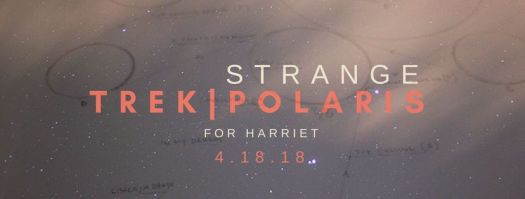
April 18th, 12- 1pm: L2L presents Dameun Strange FREE

26993874_10100130384849705_3084810090904138747_n

I’ll be a part of the premiere of Dameun’s new work Trek|Polaris  at the American Composers Forum lunchtime concert series in the Landmark Center, St Paul. 

April 21st, 9pm-12a: Adam Meckler Orchestra featuring Rex Richardson at Vieux Carré TICKETED- ticket link in event page

image1

Featuring works from the upcoming AMO album Fall Leaves and Apple Trees that we recording at Pachyderm in January. 

April 26th-29th: University of Minnesota Opera presents Offenbach’s Orpheus in the Underworld TICKETED- link in event page

Four performances of a very fun opera, for which I will be playing trombone. 

In addition to all my performances, Brass Lassie horns enter the studio in April and will be laying down our tracks for the forthcoming debut album. Look out for that in early-mid Summer!

#WCW: Deep Listening Guru Monique BuzzartĂ©

Welcome back to #wcw (aka Woman Crush Wednesday) on my blog for Women’s History Month! I’m featuring  a musical artist every Wednesday who has inspired me and driven me to expand and develop my own art in new ways.

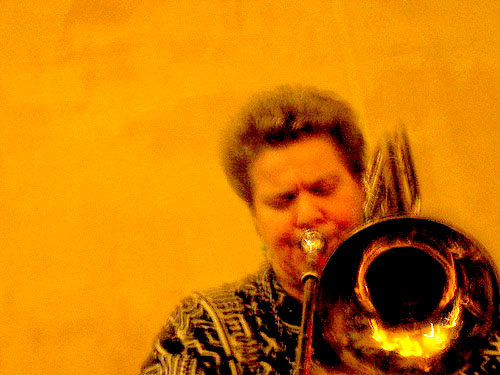
With my creative brain ever drawing me toward more improvisatory, experimental forms, I’ve been diving into the catalogue of trombonist and composer Monique BuzzartĂ©.

M_Buzzarte_austin

Known not just as a composer and avant-garde performer, Ms Buzzarté is also a champion of works by women composers and an activist fighting for the recognition and fair hiring of women in musical jobs. She maintains a database of new music for trombone by women as well as her own impressive list of compositions for music, dance, and film.

A student of Stuart Dempster and a certified practitioner of Pauline Oliveros’ Deep Listening technique, Monique draws deeply from the well of broad, ethereal sounds, utilizing tape, electronics, delay, and other instruments to bring out the mystical sounds a trombone can produce in different environments. She has developed an interactive performance interface for the trombone that allows for live processing during her performances.

If you’ve never heard of the technique of Deep Listening before, it’s definitely worth your time to explore. Many composers and performers of DL offer expansive, meditative, multi-disciplinary experiences that are meant to open the mind and the spirit to new ideas and emotions.

There’s more to listening than meets the ear.  Pauline Oliveros herself describes Deep Listening as “listening in every possible way to everything possible to hear no matter what one is doing.”  Basically Deep Listening, as developed by Oliveros, explores the difference between the involuntary nature of hearing and the voluntary, selective nature – exclusive and inclusive — of listening.  The practice includes bodywork, sonic meditations, interactive performance, listening to the sounds of daily life, nature, one’s own thoughts, imagination and dreams, and listening to listening itself.  It cultivates a heightened awareness of the sonic environment, both external and internal, and promotes experimentation, improvisation, collaboration, playfulness and other creative skills vital to personal and community growth.  Plus it’s a ton of fun.

To hear more of Ms BuzzartĂ©’s work and performances, visit the music streaming store of your choice and search her name, or visit her website for physical copies.

Happy (deep) listening!

Women’s History Month: Mentoring the Next Generation

This month on the blog I’ve talked about communities of musicians that inspire me, methods to address bias you encounter on the job, profiled some of my favorite working musicians (in multiple genres), and ran challenges on my Facebook page asking you to think about your mentors and musical ancestors, and find your next performance repertoire piece from the database of women composers.  It’s been inspiring for me to think through these posts and present them to you, and I hope it’s been inspiring to read and digest.

Today, for the last essay of Women’s History Month, I want to talk about ways in which we, the musicians working and teaching today, can mentor the next generation of performers and educators to find their desire paths and build a diverse and welcoming musical world.

I have about 30 students, and I see countless others in clinics and performances. 10 of them are young women, high school students who in addition to playing trombone, baritone, and tuba, pursue an array of extracurriculars from track & field, hockey, badminton, Irish dance, ultimate frisbee, Nordic skiing, roller derby, and softball. They study languages like Arabic, Spanish, Chinese, and French, participate in debate teams, march for their rights, and have big plans for their future and their communities.

It’s my job as their guide not to make them the best brass players they can be, but help them realize how music affects their lives and how they can use their own gained skills to express themselves in new ways. Even if they wanted to pursue music as a career, the education they received from me would not be just refining their musical and instrumental skills, but how to develop holistic, healthy attitudes and routines toward their chosen goals.

That said, I’ve been thinking a lot lately (and really, over my whole career) about the myriad ways to encourage young women and men to be the best people in music they can be. I focus on amping up my female students because they have been historically given less opportunity and have farther to climb to find recognition and success, but I give no less of my time and expertise to my male students, in hopes that their attitudes, shaped by my teaching style and example, will offer a more welcoming environment for all performers.

Here are some things I challenge myself to do as a mentor to the low brass players of the next generation:

Match attitudes to actions

I am not perfect. I carry around socialized biases about the talents and abilities of women in my brain just like everyone else, and I have to constantly work to make sure I’m not letting certain ideas or opinions shape the way I treat or teach someone. When I meet a new student, I try to establish a good rapport with them that helps them trust me, and make sure I work to understand their particular educational needs. While I hold all my students to the same standard, it’s not what you might think. My standard is: do you enjoy making music, and are you making it as efficiently and effortlessly as you can? There will be differing levels of ability and commitment, but everyone is a musician. Full stop.

Authenticity is something we define for ourselves.

I also try to combat biases that my students may hold, or that they may encounter in their musical environments. Most of my lady students are pretty savvy- they know what’s out there- but I will help them or fight for them when I see an injustice. Sometimes that means showing them how they can address something that was said to them, or helping them prepare to perform like the boss they are to quash all the naysayers.

Encourage opportunities

All of my students are encouraged to pursue extracurricular musical opportunities, if they are interested and have time. I particularly want the girls in my studio to see the different ways they can make music outside of band. This includes, but is not limited to, auditioning for youth symphonies and honor bands, participating in solo and ensemble contests as well as our studio recitals, and forming their own groups and bands in which they can use the improvisational and ear training techniques I’ve taught them to create music they want to play.

Represent and SHOW UP

I’m living representation for my girl students: I perform, practice, educate, and overall walk the walk. I try to incorporate a diverse array of performers and leaders in the field as examples and role models. I  can also try to encourage my colleagues, male and female, to take steps to diversify what and how they teach so that all their students feel empowered and respected.

There are lots of national and local gatherings and conferences for musical performers, and low brass is no exception. These should be held responsible for providing diverse presenters so that all types of people see themselves represented on stage. And I don’t mean diversity just in terms of race and gender identity, either. It’s important to see the broad spectrum of ways people can be successful as musicians, whether it’s in a large symphony orchestra or freelancing gigging in one metropolitan area. Entrepreneurship and creativity should be celebrated as much as winning “the gig.”

Listen

Believe what your students say- about their experiences, their feelings, and their motivations. See them as whole, engaged humans with agency. Don’t talk over them or refuse to acknowledge what they say because you know better. Have conversations with them, give them pep talks, tell them it is okay to stumble and sometimes even better to fail. Teach them how to get back up and try again.

I have so much faith in this coming generation to change the world. Let’s all mentor them as best we can so they have all the tools to make the music scene the place it was always meant to be.

#WCW: Mysterious Powerhouse Janelle Monáe Monáe

Welcome back to #wcw (aka Woman Crush Wednesday) on my blog for Women’s History Month! I’m featuring  a musical artist every Wednesday who has inspired me and driven me to expand and develop my own art in new ways.

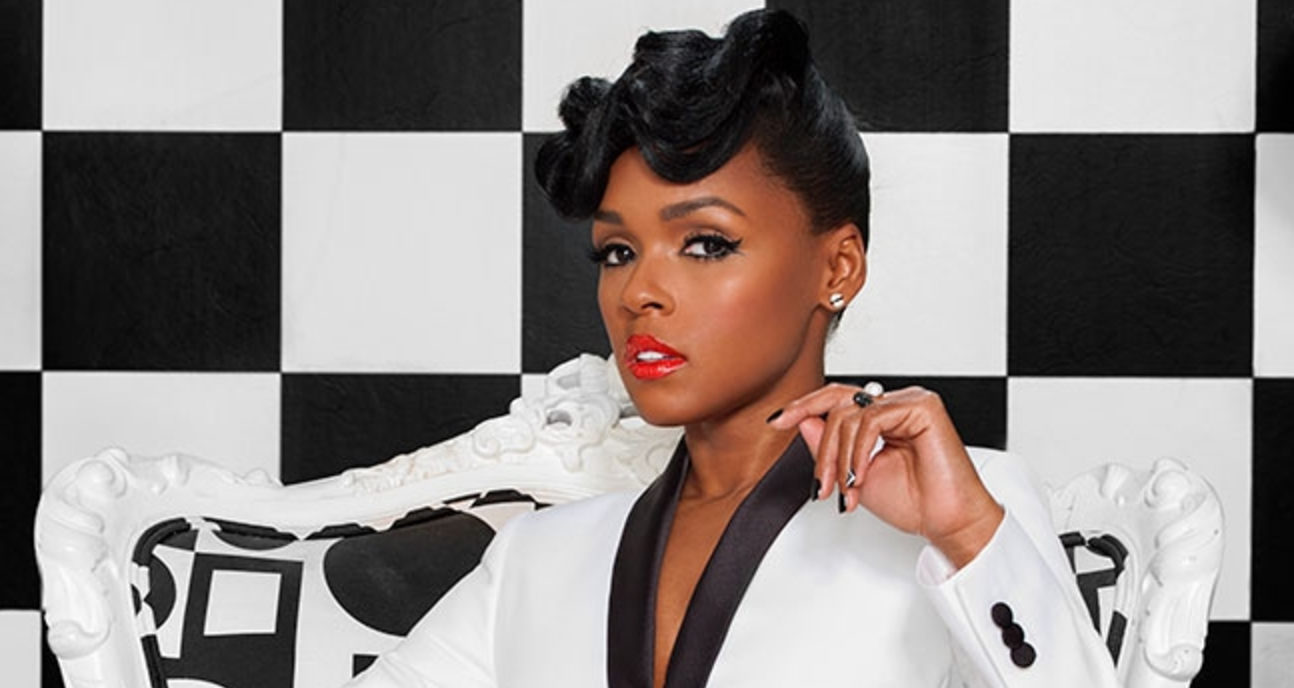
This week I’m smitten with the enigmatic, colorful, sharply intelligent, Afro-futurist musical icon that is Janelle Monáe.

QUEEN

Ms Monáe first caught the public’s attention in 2010 with the release of her critically acclaimed album The ArchAndroid, the follow-up to 2007’s Metropolis Suite I (The Chase). She revealed a plot line largely inspired by Fritz Lang’s 1927 silent film Metropolis, in which Monáe, as the android messiah Cindi Mayweather, provides a mirror to the representation of Lang’s android twin Maria. In Monáe Metropolis, Cindi represents the segregated “other.” Monáe was inspired not just by Lang’s film, but by sci-fi classics like Alien and Blade Runner,  in which the android alien was maligned and separated from society. As she says: “I could relate to that, the idea of being the minority within the majority.” (source)

poster for Fritz Lang’s Metropolis

Monáe’s signature early look, a fitted tuxedo, has won her the admiration of many for its gender-bending approaching to femininity and style. 

Born in Kansas City, Kansas, in 1985, Janelle Monáe studied drama in New York, and eventually found her way to Atlanta, Georgia, where she and like-minded artists founded the Wondaland Arts Society, bringing innovative pop culture beyond the studio and producer machine. With the release of Metropolis I, Monáe attracted the attention of big name artists like Sean Combs and Big Boi of Outkast. She’s been awarded the Vanguard Award by ASCAP. In 2016 she appeared in both Best Picture Winner Moonlight and nominated film Hidden Figures. 

She released the third album in her Metropolis concept ouevre, The Electric Lady, in 2013, and continues to follow Cindi Mayweather in her quest to liberate Metropolis’s citizens from the suppressive forces controlling their freedom of expression and love.

Her answer to the rising awareness of police brutality is the 2015 anthem Hell You Talmabout: 

Monáe music draws influence from so many genres and styles including classical & orchestral, hip-hop and soul, rockabilly, jazz, and 60s-era pop. Her latest single, Make Me Feel, bears the stamp of Minneapolis Sound legend Prince, and in fact he contributed compositional elements to the finished product before his death in 2016.

definitely NSFW, but still awesome. 

Janelle Monáe strong, unabashed voice and presence in our music scene is a breath of fresh air. She’s empowered and liberated, unconcerned with your opinion of her and willing to take risks to make great art. I eat up just about every new creation of hers, as well as her incredible style and poise. She’s, in  word, goals.

Women’s History Month: Women and the New Gig Economy

“It’s who you know, not what you know.”

Networking has always been a part of the music industry to the great advantage of some and the overlooking of a great many more. Women and other underrepresented minorities often struggle to find footing in the different branches of professional music, from classical to popular styles, and it can feel like there are extra mountains to climb just to get noticed, much less hired.

In psychology, this feeling reflects a trend toward “in-group bias” (the proverbial ‘old boys club’), in which the dominant members of a profession or group select new members based on how well they relate to them. I don’t necessarily think there is always intentional discrimination involved, but that as men in our society have been socialized primarily to interact equally with other men, this can feel like the most comfortable route to take when booking for a gig or filling a position. There’s less risk of conflict and less need to ‘speak a different language’. The end result is that a whole swath of the population that is looking for work or recognition is left out, or feels marginalized.

The fight against sexual harassment through campaigns like #metoo and #TimesUp are incredibly important, and I think go hand in hand with the ways women in the music industry are fighting for equal representation and the ability to be authentically themselves without fear of repercussions. Besides seeking visibility for the issues women and other marginalized groups face in the broader industry, I also see and participate in so many powerful internal movements that, behind the scenes and in the public eye, are changing the game for female performers. I want to highlight a few of my favorites.

Binders Full of Women

As a Minneapolis-area local, the whole game changed for me the day Andrea Swensson started a private Facebook group called “Binders Full of Women in Minnesota Music” (a spoof on Mitt Romney’s 2012 unfortunate comment about the number of female applicants he’d seen for cabinet positions).  Someone added me, and suddenly the whole diverse, beautiful community of women, female-identifying, and non binary folks in my music scene was at my fingertips. Immediately, I knew we could all use it as a place beyond networking- a place where we all felt safe, seen, and valued, a place where we could complain about an incident, spread knowledge about things going on, tell people who to avoid and who to watch out for, and most of all, HIRE EACH OTHER. A whole community of people in love with music and performing, ready to each other up.

Since becoming a part of that group, I’ve hired and been hired, attended a free clinic on sound engineering hosted by one of our members, started a roster of local freelancers, and added exponentially to my list of cool local music to listen to and support. And that leads me to my next feature…

Happy Hour! 

Last year, my good friend and collaborator Rebecca Hass and I decided to go beyond digital networking, and starting doing semi-regular happy hour meet-ups for female-identifying folks in our local music scene. Since then, we’ve hosted 3 or 4 of them (I’ve lost count!) in which a collection of women both diverse in background and musical genre have attended, trading cards and war stories, and agreed to keep in touch and promote one another. Our next venture is to host a jam session, and Rebecca has plans to do composer-specific meet-ups. It’s informal, friendly, and fun- and I’m so glad to have a colleague to coordinate it with.

BrassChix

Sarah Schmalenberger, horn & musicology professor at the University of St Thomas, and another good friend and colleague, started BrassChix ten years ago as a way to bring multiple generations and ability levels of brass-playing women together for a day of music and camaraderie. She hired me in 2012 to be the “Celebrity Trombonist” and I was delighted to present my experiences and educational philosophies to the trombonists in attendance. Since then I’ve presented or participated every year. Women are a minority in brass performance at most levels, but having a community to draw from is so important for the next generation, and so soul-fulfilling for us ‘old guard’ that are paving the way for more women to pick up brass instruments.

The Art of Asking

It’s not necessarily a community (although AFP’s fans would argue differently), but an idea- in 2013 performer Amanda Palmer presented a TED talk on “The Art of Asking” detailing the ways a new, digital marketplace could be a humongous asset to artists and musicians. She had just crowdfunded an album through the most successful Kickstarter in history to that date, and people were listening.

In some ways, I find the approach simplistic, and perhaps not the route everyone would go, but what really hit home for me is the idea that asking for what you want is not a bad thing. I think we are afraid to ask/trained not to. “American exceptionalism” tells us that we should do it all ourselves, bootstraps, etc etc. But what if we made our goals known, showed clearly how we wanted to get there, and then asked for help?

Last year, my student Caroline did something I never would have done in high school. She had an audition for her fall band assignment and it didn’t go the way she wanted to. She was convinced that she could do better, that nerves got in the way of preparation. So she went to her band director and asked for a second chance. He said yes, and after re-audiitoning, she was told she’d made it into the next level band. I was so proud of her for knowing her ability and her power that I could barely contain myself. I think maybe I cried a little bit.

Years ago I was back in my hometown of San Diego having a beer with Sean Reusch, who taught me in high school and continues to be a friend and mentor to this day. I was going through some stuff, really discouraged by the music scene in Minnesota and feeling like no one saw me. I was ready to burn it all down and do something else, ANYTHING, where I didn’t feel like a ‘woman in music’, power- and gig-less. Sean acknowledged all my concerns and then said, “You deserve to play; you’ve done the work. Now you need to ask for what you want: an opportunity, an audition, a lesson, whatever. But you need to ask, you need to be available for it.”

When I got home I messaged a few ‘power players’ on the trombone scene and asked to get together for coffee or lessons or just to be considered on a gig list. I started my professional Facebook page and started marketing myself more as an educator and unconventional performer. It hasn’t all been up from there- and I wouldn’t say I feel like the biggest trombone success on the scene, but I’m happy with the opportunities and experiences I can now rely on getting regularly.

So for #womenshistorymonth my message to you is: Go out, find your people. Ask. Share. Give. Hold each other up. The new gig economy is all of us, creating  and sharing our humanity through art.

#WCW: Sitar Star Anoushka Shankar

Welcome to the first edition of #wcw (aka Woman Crush Wednesday) on my blog for Women’s History Month! I’m featuring  a musical artist every Wednesday who has inspired me and driven me to expand and develop my own art in new ways.

Those of you who know me personally will not be surprised by the first honoree. For the past month or so since discovering her music I have been absolutely immersed in it, listening to little else in favor of catching up on her back catalogue and live performances. So without further ado, please meet Anoushka Shankar!

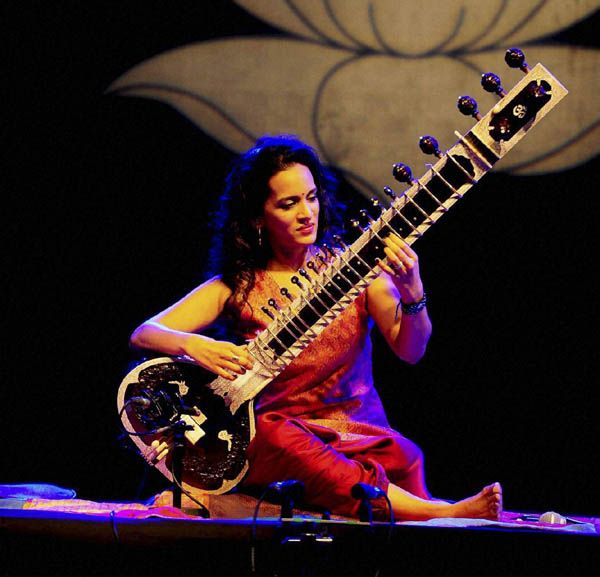
Sitarist Anoushka Shankar performs at blueFROG Amphitheatre, in Pune on Friday. PTI Photo

You may recognize the family name, and the instrument: she is indeed the daughter of famous sitarist Ravi Shankar, who came to fame in the Western music scene through the influence of the Beatles in the 60s. Anoushka was born in London in 1981 and grew up between London, Delhi, and California. Her half-sister, Norah Jones, is also a musician.

[When I say “Woman Crush Wednesday” I really mean it here: Anoushka and I are the same age, and we both went to high school in San Diego, which means WE TOTALLY COULD HAVE BEEN FRIENDS AHHHH]

She began studying sitar with her father as teacher at age 7, and grew up performing with him on stage. By 17 she had released her first album, Anoushka, and others quickly followed. She became the first woman and the youngest-ever nominee for a Grammy in World Music in 2003.

In her recent career, Anoushka has blazed a trail through modern music, combining jazz, Western classical, flamenco, electronica, and pop with her Indian classical training. She frequently performs her father’s works as well as her own.

Right this minute, you should make some time to listen to her 2013 album, Traveller. 

Combining Indian classical traditions with Spanish flamenco, Traveller is built around the idea that flamenco may have had origins in India.

“In Indian music, we call it ‘spirituality,’ and in Spanish music, it’s ‘passion,'” Shankar says. “It’s really the same thing in both forms, that reaching at the deepest part of the human soul.” -Interview for the LA Times, April 21, 2012

I’ve been most captivated by her newest work, Land of Gold, dedicated to the victims and survivors of the humanitarian crisis in Syria and refugees from other embattled nations. Central to the compositions are women’s voices:

Separate from my desire to have an established core sound at the musical heart of this album, thematically, I wanted to integrate the authority of the female voice, and the drive for women to establish personal autonomy and dignity in situations where the female perspective is often, sometimes forcibly, subdued.  –Land of Gold album notes

Guest artists on the album include hip-hop artist M.I.A and actress & activist Vanessa Redgrave reading the poetry of Pavana Reddy.

https://www.youtube.com/watch?v=ajuB6ani5nU

Favorite tracks: Crossing the Rubicon, Remain the Sea]

More than anything what has drawn me to Anoushka Shankar in recent weeks is the pure passion and creativity with which she approaches her work. She sits comfortably on stage, brings her in collaborators with smiles and moments of shared groove, and invites the audience to feel the music with her- it is art and love and joy.

I hope you enjoy it as much as I do.

[Shankar is touring the US this month & next: find her at the Big Ears Festival in Tennessee, playing Philip Glass with the Pacific Symphony in California and at Carnegie Hall in NY]

Women’s History Month 2018

Women are always making history, of course, but we get official about it in March. Next Thursday, March 8th, is International Women’s Day. Originally observed by suffragettes in the United States and factory workers in Russia, IWD now convenes internationally to celebrate the cultural, political, social, and economic achievements of women worldwide.

On the blog this month I’ll be celebrating musical women; highlighting not just brass and classical players but a wide variety of ladies making strides in the music world. Over on Facebook you can find a link to the Women Composers Database, a resource for finding your next performance piece. On Wednesdays we’ll celebrate #wcw – that’s ‘woman crush wednesday’ for you non-hashtag-hip folks- by showcasing a woman in music who’s really inspiring us. I’ve got a great one for this week and I can’t wait to share her music with you.

And Fridays are challenge days. Watch my Facebook page for a prompt from me asking you to share something or seek out some knowledge and report back. Let’s all grow our knowledge of women in the music industry and help promote their visibility!

Happy Women’s History Month!

Black History Month Roundup

Here on the blog and over at my Facebook page, it’s been great fun exploring the dynamic and depth of music from African and its diaspora. As a roundup, today’s blog is a master post of all the things I’ve shared and you’ve shared with me!

On the blog

February- Black History Month 

A discussion about whether or not Justin Timberlake can adequately play homage to Prince, a man with whom he had a noted feud.

Black History Month: Getting Ready for Black Panther

Representation and music inspired by Black Panther- the Kendrick Lamar soundtrack; Gil Scott-Heron’s “The Revolution Will Not Be Televised” and current politics.

Black History Month: African Inspiration

Covering the score & soundtrack to Black Panther, and where the composer,  Ludwig Göransson, got his inspiration.

On Facebook

Thread– Your favorite musical artists of African heritage. Some shares:

Re: Donald Glover

Resources & Challenges:

Jazz & Its Feminist Future

Test Your Implicit Bias

What’s Your Magic? 

Coming in March: Women’s History Month!

Getting geared up to celebrate women in music (and in all things) in March. Stay tuned!


February- Black History Month

In honor of Black History Month, this blog and my other social media spaces will be sharing thoughts, performances, and resources  from and about Black artists. There’s an incredible amount of music in the world created by Black performers and composers, and one month can’t do it justice, but we are going to try! Hopefully the things we explore here together will lead to lifelong conversations and celebrations of the things we discover.

There’s a thread running on my Facebook page asking you to share your favorite artists of African heritage. Join in the discussion and come away with a new favorite!

Meantime, what did you think of Justin Timberlake’s tribute to Prince at the Super Bowl? Tasteful? Boring? Great? An assault on the Purple One’s legacy? In an opinion piece that argues the latter, Dante A Ciampaglia notes that Prince, hyper-viligiant of the use of his music and his image, would have be horrified to be remembered so. It brings up questions of what we allow ourselves when a beloved artist passes away, what they give up in order for us to memorialize them. Paisley Park is now a glorified theme attraction, Prince’s music is released on all the streaming services, and his image and reputation are being used to bring prestige and financial gain to artists and locations throughout the country. There are, of course, upsides to this for the average fan, but do you think we are managing Prince’s legacy correctly? Or are we selling him out? Does a white, privileged musician like JT, whose own career has been driven by the  appropriation of black music and musicians, deserve the honor?